You cooked on Sunday. It is now Thursday. The container looks fine. It smells fine. You eat it anyway, and an hour later you understand the mistake. The 3 to 4 day rule for leftovers is not a conservative guideline invented by overcautious government agencies. It is based on documented bacterial growth rates, and the most dangerous part is that the bacteria responsible for most leftover-related illness produce no smell, no visible mold, and no change in texture before they reach levels that make you sick.
How long do leftovers last?
The short answer: Most cooked leftovers last 3 to 4 days in the refrigerator and 2 to 6 months in the freezer, according to the USDA Food Safety and Inspection Service. The 3 to 4 day rule applies to virtually all cooked dishes: chicken, beef, fish, pasta, soup, rice, pizza, and casseroles. A small number of items vary slightly, and the type of container and how quickly you refrigerated the food affect actual shelf life within that window.
For storage guidance on specific ingredients before they become leftovers, see our Food Storage Guide. For how quickly specific ingredients spoil before you cook them, see 15 foods that go bad faster than you think.
📋 How Long Do Leftovers Last: At a Glance
| 🍗 Cooked chicken or turkey | 3 to 4 days fridge |
| 🥩 Cooked beef, pork, lamb | 3 to 4 days fridge |
| 🐟 Cooked fish and seafood | 3 to 4 days fridge |
| 🍕 Pizza | 3 to 4 days fridge |
| 🍝 Cooked pasta | 3 to 5 days fridge |
| 🍚 Cooked rice | 3 to 4 days fridge (recommended) |
| 🥣 Soup and stew | 3 to 4 days fridge |
| 🥔 Mashed potatoes | 3 to 5 days fridge |
🔑 Key Takeaways
- The USDA says 3 to 4 days for most cooked leftovers in the refrigerator. This is not conservative: it is based on the rate at which harmful bacteria multiply at refrigerator temperatures.
- Many of the bacteria that cause leftover-related food poisoning (Listeria, Salmonella, certain E. coli strains) produce no detectable smell, no visible mold, and no color change. Looking and smelling fine is not evidence of safety past day 4.
- The 2-hour rule matters as much as the 4-day rule. Food left at room temperature for more than 2 hours (1 hour above 90 degrees Fahrenheit) has already entered dangerous territory. Refrigerating it afterward does not undo the bacterial growth that occurred.
- Freezer storage is safe indefinitely at 0 degrees Fahrenheit. Quality declines over time: most cooked dishes are best eaten within 2 to 3 months for texture and flavor.
- Reheating leftovers does not reset the 3 to 4 day clock. If chicken has been in the fridge for 3 days and you reheat half of it, the other half is still only safe for 1 more day, not another 3 to 4.
Why 3 to 4 Days, Not 7
Refrigeration slows bacterial growth but does not stop it. Even at 40 degrees Fahrenheit, the pathogens that cause foodborne illness continue to multiply, just more slowly than at room temperature. After 3 to 4 days, bacterial counts in refrigerated cooked food can reach levels that cause illness in healthy adults. For high-risk groups including older adults, young children, pregnant women, and anyone immunocompromised, the risk arrives sooner.
🔬 Why You Cannot Smell the Danger
The bacteria responsible for most leftover-related illness are not the same bacteria that cause food to smell bad. Spoilage bacteria (the ones that make food smell sour or look moldy) are largely harmless. Pathogenic bacteria (the ones that make you sick) are a different group entirely, and many of them produce no odor, no color change, and no visible sign of their presence. This is why the USDA and Mayo Clinic both explicitly warn against the “sniff test” as a safety method for leftovers. A leftover that smells perfectly fine on day 5 may still contain dangerous levels of Listeria or Salmonella.
How Long Do Specific Leftovers Last
All refrigerator times below assume the food was refrigerated within 2 hours of cooking, stored at 40 degrees Fahrenheit or below, and kept in a sealed airtight container. All figures are from USDA FoodKeeper and USDA FSIS guidance unless otherwise noted.
Cooked Chicken and Turkey
Cooked chicken and turkey last 3 to 4 days in the refrigerator, according to USDA FoodKeeper. This applies to roasted, grilled, baked, poached, or fried preparations, whether the meat is whole, sliced, shredded, or mixed into a dish. Chicken salad mixed with mayo also follows the 3 to 4 day rule, with the added caveat that the mayonnaise component is independently time-sensitive.
⚠️ Holiday Turkey: Plan to Freeze It
USDA FoodKeeper puts cooked turkey at the same 3 to 4 day window as cooked chicken. The practical risk with holiday turkey is not the timeline itself but how much time passes before refrigeration. Turkey that was carved and held at serving temperature for 2 to 3 hours before refrigeration has significantly less safe storage time remaining than the full 3 to 4 days. The USDA recommends refrigerating carved turkey within 2 hours of cooking. If you have more than you will eat in 3 days, freeze it the night of the meal.
Freezer: 4 months for cooked chicken. 2 to 6 months for cooked turkey. Our teriyaki pork bowls and steak tacos both work well with leftover cooked protein used within the first 2 to 3 days.
Cooked Beef, Pork, and Lamb
Cooked beef, pork, and lamb last 3 to 4 days in the refrigerator. This covers steaks, roasts, chops, meatloaf, meatballs, and mixed dishes where these meats are the primary protein. Cooked ground meat follows the same 3 to 4 day rule. Meats covered in gravy or broth also fall under the 3 to 4 day window, the same as the meat itself.
Freezer: 2 to 3 months for cooked meat dishes. Our classic meatloaf freezes well in individual slices for up to 3 months. Our Greek-style pork loin is another dish where leftovers are best used within 3 days or frozen.
Cooked Fish and Seafood
Cooked fish and seafood last 3 to 4 days in the refrigerator. However, because fish continues to develop stronger odors even after cooking as proteins break down further, most people find it noticeably less pleasant by day 3. The quality window is shorter than the safety window. Cooked shrimp, crab, and lobster follow the same 3 to 4 day rule.
Freezer: 3 months for cooked fish. Our tuna tostadas, BBQ shrimp tacos, and clam corn chowder are all best eaten fresh or within 2 days for peak quality.
Pizza
Leftover pizza lasts 3 to 4 days in the refrigerator. This applies to all crust types and toppings. Pizza with meat toppings (sausage, pepperoni, ham) should not be pushed past day 4.
✅ Reheating Tip
Cold leftover pizza left on the counter while you wait for the oven to preheat is fine for up to 30 minutes. Do not leave it out longer. For the crispiest reheat, a skillet over medium heat for 2 to 3 minutes covered beats the microwave every time. Pizza left on the counter overnight should be discarded: it will have spent more than 2 hours at room temperature.
Freezer: 1 to 2 months. Freeze individual slices separated by parchment paper and reheat directly from frozen in a 375 degree oven.
Cooked Pasta
Cooked pasta lasts 3 to 5 days in the refrigerator when stored without sauce, according to USDA FoodKeeper. Pasta stored with sauce lasts 3 to 4 days, limited by the sauce component rather than the pasta itself. Plain cooked pasta at the 5 day mark is primarily a quality question: it may be gummy or dry but is not typically a food safety concern if properly stored. Pasta combined with meat, seafood, or a dairy-based sauce should always be treated as a 3 to 4 day item. See does pasta go bad for full guidance.
Freezer: Pasta in sauce freezes for 2 to 3 months. Plain pasta alone does not freeze well: it becomes mushy after thawing. Freeze the sauce separately and cook fresh pasta when you are ready to eat. See our foods you should never freeze guide for the explanation.
Cooked Rice
Cooked rice lasts 3 to 4 days in the refrigerator as the recommended safe limit, though USDA FoodKeeper lists the range as up to 4 to 6 days under ideal storage conditions. Given the specific food safety risk associated with rice, the conservative 3 to 4 day guideline is the right one to follow. Rice carries a risk that most people are unaware of: Bacillus cereus, a bacterium whose spores survive cooking and can produce toxins if cooked rice cools slowly or is stored improperly. Because of this, rice should be treated more carefully than other cooked starches, not less. See does rice go bad for full guidance.
⚠️ The Rice Rule
Cool cooked rice quickly and refrigerate within 1 to 2 hours of cooking. Never leave cooked rice in a covered pot on the stove overnight: room temperature is ideal for Bacillus cereus toxin production. Reheat rice to 165 degrees Fahrenheit throughout before eating. Do not reheat cooked rice more than once.
Freezer: 1 to 2 months for cooked rice.
Soup and Stew
Soup and stew last 3 to 4 days in the refrigerator. This applies to broth-based, tomato-based, cream-based, and bean-based soups equally. A large pot of soup takes a long time to cool in the refrigerator, which can leave the center in the danger zone (40 to 140 degrees Fahrenheit) for extended periods. The USDA recommends dividing large quantities of soup into shallow containers before refrigerating so the temperature drops quickly throughout.
Divide soup into containers no more than 2 to 3 inches deep before refrigerating. For a large batch, place the containers in a sink with ice water for 15 to 20 minutes before putting them in the fridge. This drops the temperature through the danger zone in minutes rather than hours. Our tortilla soup, red lentil soup, and clam corn chowder all freeze well for up to 3 months if you make a large batch.
Freezer: 2 to 3 months for most soups and stews. Cream-based soups are best frozen without the cream: add fresh cream when reheating.
Mashed Potatoes and Potato Dishes
Mashed potatoes last 3 to 5 days in the refrigerator. For full potato storage guidance see do potatoes go bad. Roasted or baked potato pieces last 3 to 4 days. Potato salad with mayonnaise is a stricter case: the combination of cooked potato, mayo, and often eggs means 3 to 4 days maximum. Potato salad that was served at room temperature for more than 2 hours should be discarded rather than refrigerated.
See also

Freezer: Mashed potatoes made with butter and cream freeze for 2 to 3 months. Cubed or roasted potatoes do not freeze well: they become mealy and waterlogged after thawing.
Casseroles and Mixed Dishes
Casseroles, baked dishes, stir fries, curries, and other mixed dishes last 3 to 4 days in the refrigerator. The shelf life is always determined by the most perishable ingredient. A vegetable casserole with a cream sauce is limited by the cream. A mixed dish with chicken and rice is limited by the chicken. When in doubt, apply the 3 to 4 day rule regardless of what the dish contains. Our crustless veggie quiche, spinach artichoke dip, and Greek meze board are all dishes where leftovers are best finished within 3 days.
Freezer: 2 to 3 months for most casseroles and mixed dishes.
Chinese Takeout and Restaurant Leftovers
Restaurant leftovers follow exactly the same rules as home-cooked food: 3 to 4 days in the refrigerator. The restaurant origin does not extend safe storage time. Factor in how long the food spent in transit and at room temperature before you refrigerated it: that time counts against the 2-hour rule and reduces the remaining safe window accordingly.
The Rules That Matter as Much as the Shelf Life
The 2-Hour Rule
Refrigerate leftovers within 2 hours of cooking or serving. If the ambient temperature is above 90 degrees Fahrenheit (an outdoor barbecue, a hot car), that window drops to 1 hour. Food left in the danger zone longer than this has already accumulated bacterial growth that refrigeration will not undo. The USDA is explicit on this: perishable food left at room temperature for more than 2 hours should be discarded.
⚠️ The Common Mistake
Many people wait for food to cool to room temperature before refrigerating it, believing that putting hot food in the fridge is harmful to the refrigerator or other foods. The USDA says this is not necessary and can make food unsafe. Hot food can go directly into the refrigerator. Leave a corner of the lid ajar until the food cools, then seal. Modern refrigerators handle hot food without a problem. Waiting on the counter is the dangerous step.
The Container Rule
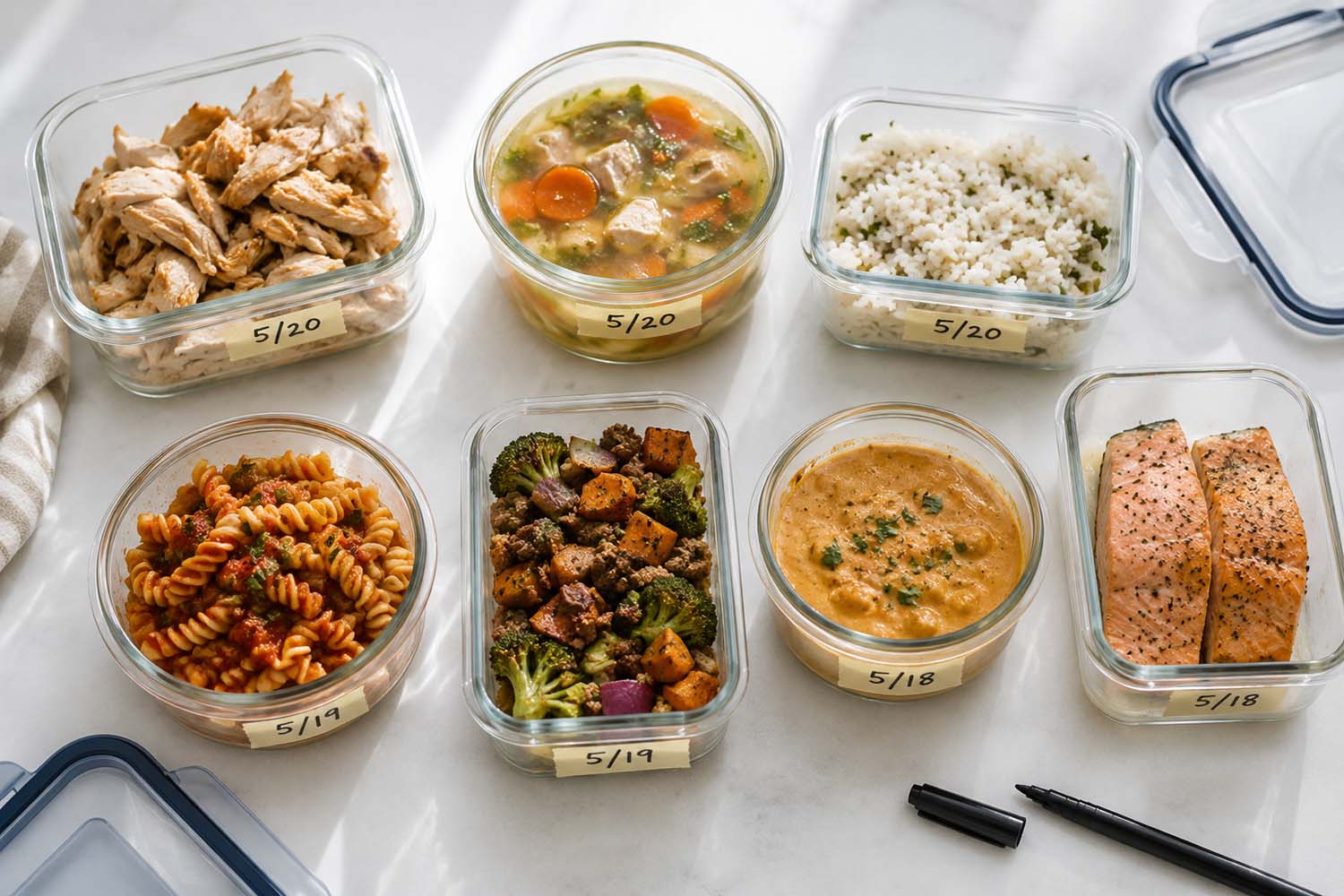
Leftovers must be stored in airtight containers or wrapped tightly. Loose wrapping or an uncovered dish allows bacteria from the refrigerator air to reach the food, accelerates moisture loss, and allows odors to transfer between foods. Glass or hard plastic containers with tight-fitting lids are ideal. Divide large quantities into smaller shallow containers (no more than 2 to 3 inches deep) so food cools quickly and evenly throughout.
The Reheating Rule
Always reheat leftovers to an internal temperature of 165 degrees Fahrenheit throughout, measured with a food thermometer. For soups and gravies, bring to a full rolling boil. Cover when reheating to retain moisture and ensure even heat distribution. When using a microwave, rotate or stir partway through to eliminate cold spots, then let the food stand for 2 minutes before checking the temperature: heat continues to distribute during standing time.
The One-Reheat Rule
Reheat leftovers only once. Each heating and cooling cycle creates additional opportunities for bacterial growth and toxin production, particularly in rice and grain dishes. If you reheated a dish and have portions remaining, discard them rather than refrigerating and reheating again.
Complete Leftover Shelf Life Table
| Food | Refrigerator (40°F) | Freezer (0°F) |
|---|---|---|
| Cooked chicken or turkey (pieces) | 3 to 4 days | 4 months |
| Cooked beef, pork, lamb (steaks, roasts, chops) | 3 to 4 days | 2 to 3 months |
| Cooked ground meat | 3 to 4 days | 2 to 3 months |
| Cooked fish and seafood | 3 to 4 days | 3 months |
| Pizza | 3 to 4 days | 1 to 2 months |
| Cooked pasta (plain, no sauce) | 3 to 5 days | Not recommended |
| Cooked pasta (with sauce or protein) | 3 to 4 days | 2 to 3 months |
| Cooked rice | 3 to 4 days (recommended) | 1 to 2 months |
| Cooked grains (quinoa, farro, oats) | 3 to 5 days | 1 to 2 months |
| Soup and stew | 3 to 4 days | 2 to 3 months |
| Mashed potatoes | 3 to 5 days | 2 to 3 months |
| Casseroles and mixed dishes | 3 to 4 days | 2 to 3 months |
| Egg dishes (quiche, frittata, scrambled) | 3 to 4 days | 2 to 3 months |
| Potato salad (with mayo) | 3 to 4 days | Not recommended |
| Cooked vegetables | 3 to 4 days | 2 to 3 months |
| Gravy (standalone, homemade) | 1 to 2 days | 2 to 3 months |
| Meats in gravy or broth | 3 to 4 days | 6 months |
Source: USDA Food Safety and Inspection Service, USDA FoodKeeper, FoodSafety.gov
Frequently Asked Questions
How long do leftovers last in the fridge?
Most cooked leftovers last 3 to 4 days in the refrigerator, according to the USDA Food Safety and Inspection Service. This applies to cooked chicken, beef, fish, pasta, soup, rice, pizza, and casseroles. Plain cooked pasta and mashed potatoes can last up to 5 days, but 3 to 4 days is the safe standard for virtually all cooked dishes containing protein.
How long does cooked chicken last in the fridge?
Cooked chicken lasts 3 to 4 days in the refrigerator, according to USDA FoodKeeper. This applies to all preparations: roasted, grilled, baked, fried, or poached, whether whole pieces, sliced, or shredded. Chicken in a mixed dish (soup, casserole, stir fry) also follows the 3 to 4 day rule. Freeze cooked chicken for up to 4 months if you will not use it within that window.
How long does leftover pizza last?
Leftover pizza lasts 3 to 4 days in the refrigerator. Store slices in an airtight container or wrapped tightly to prevent the crust from drying out and the cheese from absorbing refrigerator odors. Reheat to steaming hot throughout. Pizza left on the counter overnight should be discarded: it will have spent more than 2 hours at room temperature.
Cooked rice is safe for 3 to 4 days in the refrigerator as the recommended conservative limit. USDA FoodKeeper lists up to 4 to 6 days under ideal storage, but given rice’s specific Bacillus cereus risk, 3 to 4 days is the right guideline to follow. Cool rice quickly, refrigerate within 1 to 2 hours of cooking, and reheat to 165 degrees Fahrenheit before eating. Do not reheat cooked rice more than once. See does rice go bad for full guidance.
How long does soup last in the fridge?
Homemade soup lasts 3 to 4 days in the refrigerator. To cool it safely, divide into shallow containers (2 to 3 inches deep) before refrigerating so the temperature drops quickly throughout. A large pot left whole can stay in the danger zone at its center for hours. Freeze soup for 2 to 3 months for longer storage. Cream-based soups are best frozen without the cream component: add fresh cream when reheating.
Cooked ham lasts 3 to 4 days in the refrigerator, according to USDA FoodKeeper. This applies to baked, glazed, or sliced cooked ham. Ham in a casserole or mixed dish follows the same 3 to 4 day rule. Freeze cooked ham for 1 to 2 months. For full guidance, see does ham go bad and how long can you keep ham in the fridge.
Can you eat leftovers after 5 days?
For most cooked dishes, no. The USDA says 3 to 4 days for the vast majority of cooked leftovers. At day 5, bacterial counts in many cooked foods can reach levels that cause illness in healthy adults, and the risk is higher for vulnerable groups. The food may look and smell normal while harboring unsafe levels of bacteria. When in doubt, throw it out.
Does reheating leftovers reset the 3 to 4 day clock?
No. Reheating does not reset the storage clock. If chicken has been in the refrigerator for 3 days and you reheat half of it, the other half has 1 day remaining, not another 3 to 4 days. Reheating kills bacteria present at the time but does not reverse the degradation that has already occurred or prevent bacteria from multiplying again during the next cooling cycle.
Is it OK to eat cold leftovers without reheating?
It depends on the food. Cold leftovers that are safe to eat cold (cooked pasta salad, cold roasted chicken, leftover pizza) are fine to eat without reheating as long as they are within the 3 to 4 day window and were stored properly. For meat, poultry, seafood, egg dishes, and casseroles, the USDA recommends reheating to 165 degrees Fahrenheit before eating, particularly for high-risk groups. Eating these foods cold is not automatically unsafe if they were properly stored, but reheating to 165 degrees eliminates the residual risk.
How do you know if leftovers have gone bad?
Sometimes you cannot tell without checking the date, because many dangerous bacteria produce no smell, no mold, and no visible change. Clear signs that leftovers have spoiled include a sour or off smell, any visible mold (including small spots), a slimy texture on meat or poultry, and unusual discoloration. If leftovers are past 4 days in the fridge regardless of appearance, discard them.
Can you put hot food directly in the refrigerator?
Yes. The USDA says hot food can go directly into the refrigerator. The old advice to let food cool on the counter first is outdated and potentially unsafe: cooling at room temperature keeps food in the danger zone longer than necessary. Hot food can go straight into the fridge. Leave a corner of the lid ajar until the food cools, then seal it. Modern refrigerators handle hot food without a problem.
How long do Chinese takeout leftovers last?
Chinese takeout and all restaurant leftovers follow the same rules as home-cooked food: 3 to 4 days in the refrigerator. The restaurant origin does not extend safe storage time. Factor in how long the food was in transit and at room temperature before you refrigerated it: that time counts against the 2-hour rule and reduces the remaining safe window.
How long can leftovers sit out at room temperature?
No more than 2 hours at typical room temperature (below 90 degrees Fahrenheit). Above 90 degrees Fahrenheit, the limit drops to 1 hour. After 2 hours in the danger zone (40 to 140 degrees Fahrenheit), bacteria in perishable food can multiply to unsafe levels. Refrigerate promptly or discard.
How long do leftovers last in the freezer?
Frozen leftovers are safe indefinitely at 0 degrees Fahrenheit because freezing stops bacterial growth entirely. Quality declines over time. For best texture and flavor: cooked chicken 4 months, cooked beef or pork 2 to 3 months, soup 2 to 3 months, casseroles 2 to 3 months, cooked rice 1 to 2 months. Label everything with the date before freezing.
What temperature should leftovers be reheated to?
All leftovers should be reheated to an internal temperature of 165 degrees Fahrenheit throughout, according to the USDA. Use a food thermometer to verify. Soups, gravies, and sauces should be brought to a full rolling boil. In the microwave, stir or rotate partway through reheating to eliminate cold spots, then let the food stand for 2 minutes before checking the temperature.
How long do mashed potato leftovers last?
Mashed potatoes last 3 to 5 days in the refrigerator. Store in an airtight container. Mashed potatoes made with butter and cream freeze well for 2 to 3 months: reheat gently with a splash of cream or milk to restore consistency. Mashed potatoes made with just milk may become slightly gluey after freezing.
Further Reading
Better Living may earn commissions through affiliate links and may occasionally feature sponsored or partner content. If you make a purchase through our links, we may receive a small commission at no cost to you.