You are halfway through a batch of pancake batter and the buttermilk carton is empty. Or the recipe calls for a full cup, and the store only sells it in a quart you will use once and forget. Or you are lactose intolerant and want the tang without the dairy. Whatever the reason, buttermilk is one of the easiest ingredients to replace. Its two jobs, adding acidity and adding moisture, can both be recreated with staples you probably already have in your kitchen.
What can you use instead of buttermilk?
The short answer: Milk mixed with lemon juice or vinegar, plain yogurt, sour cream, kefir, cream of tartar mixed with milk, reconstituted buttermilk powder, plain milk, and non-dairy milk mixed with vinegar all work as buttermilk substitutes. The right pick depends on whether your recipe needs the acid for leavening, the tang for flavor, or just the liquid and fat. Most substitute at a 1:1 ratio. The best choice depends on whether you are baking, marinating, or making a dressing, and whether you need a dairy-free option.
For full storage guidance on buttermilk itself, see our companion posts: does buttermilk go bad and does buttermilk need to be refrigerated. For a complete pantry reference, see our Food Storage Guide.
📋 Buttermilk Substitutes at a Glance
| 🥛 Milk and lemon juice or vinegar | 1:1 ratio, DIY acid substitute |
| 🥣 Plain yogurt, thinned with milk | 1:1 ratio, baking and richness |
| 🍶 Sour cream, thinned with milk | 1:1 ratio, pancakes and biscuits |
| 🧫 Kefir | 1:1 ratio, closest flavor match |
| 🫙 Cream of tartar and milk | 1.75 tsp per cup of milk, citrus-free fix |
| 📦 Buttermilk powder and water | Per package directions, shelf-stable backup |
| 🌱 Non-dairy milk and vinegar | 1:1 ratio, dairy-free substitute |
| 🥛 Plain milk | 1:1 ratio, no baking soda in recipe |
🔑 Key Takeaways
- Buttermilk serves two functions in cooking. It reacts with baking soda to leaven baked goods, and its tangy acidity plus moisture tenderizes batters, doughs, and marinated meat. The best substitute depends on which function your recipe needs.
- For leavening, you need real acidity. Milk mixed with lemon juice or vinegar, plain yogurt, sour cream, and kefir all work. Each one’s acid activates baking soda the same way buttermilk does.
- For flavor and tang without a leavening role, kefir is the closest match to real cultured buttermilk, followed closely by thinned yogurt.
- For a dairy-free substitute, soy milk mixed with lemon juice or vinegar is the most reliable option. Its protein content lets it curdle in a way similar to dairy. Lower-protein options like oat or coconut milk still work for leavening but will not thicken the same way.
- Plain milk alone is a reasonable last resort in recipes that do not rely on acid for lift, but it will not replicate the tang or the leavening power of real buttermilk.
Understanding What Buttermilk Actually Does
Before choosing a substitute, it helps to know which of buttermilk’s two jobs your recipe is actually asking for. Store-bought buttermilk today is pasteurized milk cultured with lactic acid bacteria, which gives it a tangy flavor and a texture thicker than regular milk. That acidity is the whole reason recipes call for it.
🔬 Two Jobs, Two Different Substitutes
As a leavening agent, buttermilk’s acidity reacts with baking soda to produce carbon dioxide. That reaction is what gives pancakes, biscuits, and quick breads their rise and lightness. A recipe built on baking soda and buttermilk cannot simply swap in plain milk without losing that lift. Recipes built around baking powder instead are more forgiving, since baking powder already contains its own acid and does not depend on buttermilk to activate.
As a tenderizer and flavor agent, buttermilk’s acidity breaks down gluten strands in batters and doughs, producing a softer crumb. It does the same to proteins in a marinade, which is why it shows up so often as the base for fried chicken. For this job you need something with real acid content and enough body to coat and cling.
Not every substitute works equally well for both jobs. Plain milk provides moisture but no meaningful acid, so it will not activate baking soda the way milk mixed with vinegar will. Kefir and thinned yogurt provide both the acid and a similar thickness to real buttermilk, which is why they are often the closest match.
The Best Buttermilk Substitutes
1. Milk and Lemon Juice or Vinegar (Best All-Purpose Substitute)
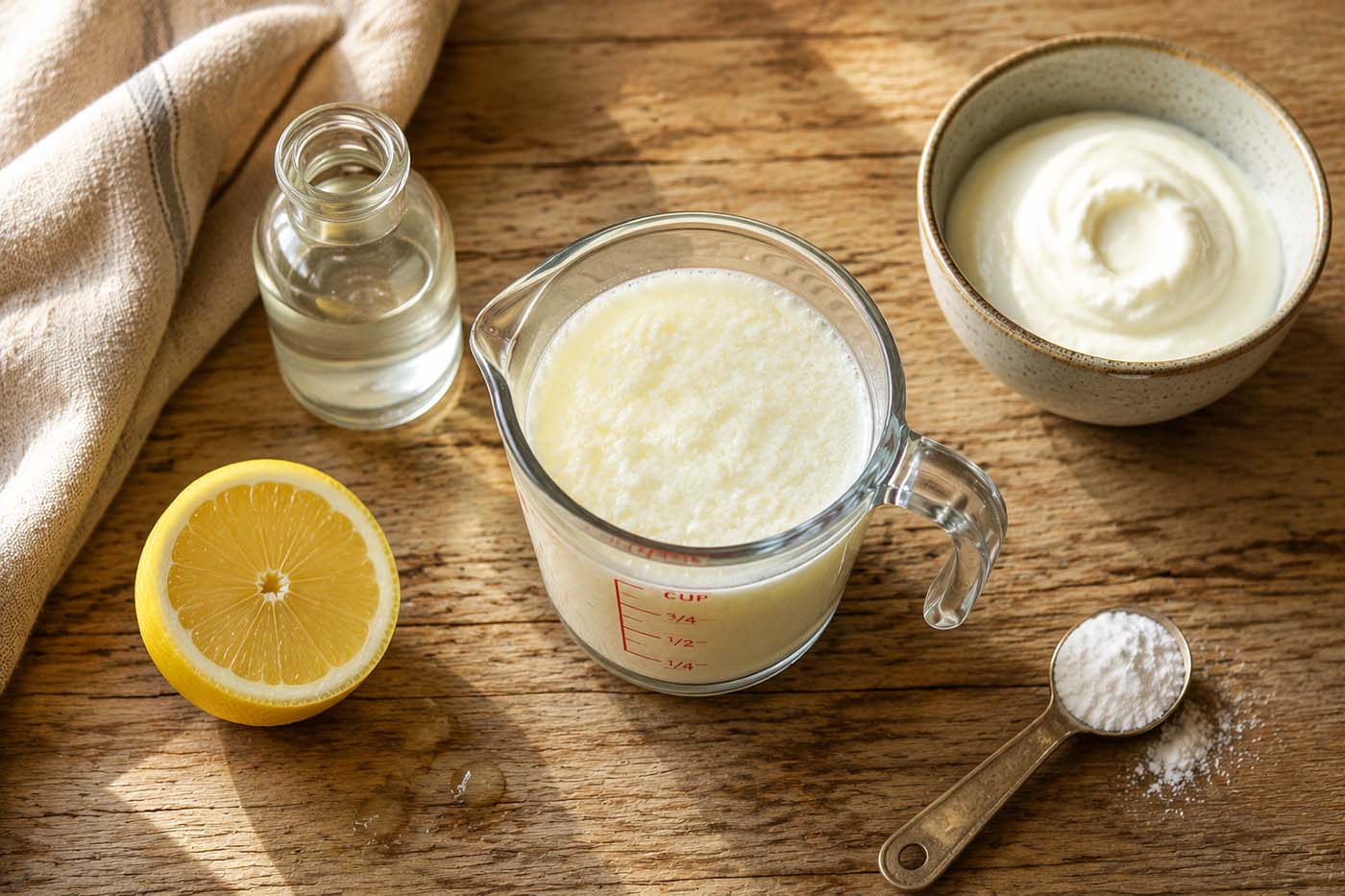
This is the classic DIY buttermilk fix and the most reliable substitute for nearly any recipe. Stir 1 tablespoon of lemon juice or white vinegar into 1 cup of milk. Let it sit at room temperature for 5 to 10 minutes. The milk will thicken slightly and small curdled flecks will appear. That is the acid doing its job, and it is exactly the reaction the recipe needs. Whole milk gives the richest result, but 2 percent or even skim milk will work in a pinch.
Lemon juice adds a faint citrus note that is undetectable in most baked goods but slightly noticeable in dressings or dips. White vinegar is more neutral in flavor. Choose it when you do not want any citrus taste coming through.
Ratio: 1 tablespoon lemon juice or vinegar per 1 cup milk
Note: Let it rest 5 to 10 minutes before using. Do not strain out the small curds, they are meant to be there.
2. Plain Yogurt, Thinned with Milk (Best for Richness and Baking)
Plain yogurt is naturally tangy and acidic, which makes it an excellent buttermilk substitute in baked goods. Because yogurt is thicker than buttermilk, whisk it with a little milk or water until it reaches a pourable consistency. Aim for roughly 3 parts yogurt to 1 part milk. Full-fat plain yogurt gives the richest crumb. Greek yogurt needs a bit more thinning liquid since it starts out thicker.
Use plain, unsweetened yogurt only. Flavored or sweetened varieties will throw off both the acidity level and the flavor of the finished dish. If you keep yogurt around often, see our guide on how long it lasts to spot when it’s turned.
✅ Best for: Cakes, muffins, quick breads, biscuits, marinades for chicken.
Ratio: 3/4 cup yogurt plus 1/4 cup milk per 1 cup buttermilk
Note: Use plain, unsweetened yogurt. Greek yogurt will need slightly more thinning liquid.
3. Sour Cream, Thinned with Milk (Best for Pancakes and Biscuits)
Sour cream shares buttermilk’s tang and acidity, producing an especially tender, rich result in pancakes and biscuits. Like yogurt, sour cream is too thick to use straight. Whisk it with milk until it loosens to a pourable consistency, roughly 3 parts sour cream to 1 part milk.
The higher fat content in sour cream means baked goods often come out slightly denser and richer than the original. Many bakers consider that an upgrade rather than a compromise in biscuits and scones. Leftover sour cream keeps for a while in the fridge. See our guide on how long sour cream lasts if you’re working through an open container.
✅ Best for: Pancakes, biscuits, scones, coffee cake, dips and dressings.
Ratio: 3/4 cup sour cream plus 1/4 cup milk per 1 cup buttermilk
Note: Produces a richer, denser result than buttermilk due to higher fat content.
4. Kefir (Best Flavor Match and Probiotic Swap)
Kefir is a fermented, drinkable dairy product with a tang and consistency close to real buttermilk. It lands closer than almost any other substitute because both are cultured with live bacteria in a similar way. It pours easily and needs no thinning. Swap it in at a straight 1:1 ratio in virtually every recipe, from pancakes to marinades to salad dressings.
Kefir also carries the same probiotic benefits that traditional buttermilk is known for, since both are cultured dairy products. For more on how fermented dairy fits into a gut-friendly diet, see our guide to the top 20 probiotic foods.
✅ Best for: Pancakes, waffles, biscuits, fried chicken marinades, smoothies, salad dressings.
Ratio: 1:1
Note: No thinning needed. Plain, unsweetened kefir only.
5. Cream of Tartar and Milk (Best Citrus-Free Pantry Fix)
Cream of tartar is a dry acid. Whisking it directly into milk gives you a leavening boost without reaching for lemon juice or vinegar. Whisk 1.75 teaspoons of cream of tartar into 1 cup of milk until fully dissolved. It will not thicken or curdle the way milk and vinegar does, so don’t expect the same visual cue. The acid content is there, and it works.
This substitute is useful if you keep a well-stocked baking pantry. It works even without fresh lemons or an open bottle of vinegar on hand. Like most dry baking staples, cream of tartar keeps for a long time in the pantry. See our guide on how long cream of tartar lasts for the details.
✅ Best for: Pancakes, biscuits, quick breads, any recipe leaning on baking soda for lift.
Ratio: 1.75 teaspoons cream of tartar per 1 cup milk
Note: Will not curdle or thicken visibly like milk and vinegar. Whisk until fully dissolved before using.
6. Buttermilk Powder and Water (Best Shelf-Stable Backup)
Buttermilk powder is dehydrated cultured buttermilk that keeps in the pantry for months. The carton version, by contrast, spoils within a couple of weeks of opening. Reconstitute the powder with water according to the package directions, typically a few tablespoons per cup of water. Use it exactly as you would fresh buttermilk.
Keeping a container of buttermilk powder on the shelf means you are never caught without it for a recipe. It also avoids a common problem: buying a full carton for one recipe and letting the rest go to waste. See our guide on whether buttermilk needs to be refrigerated for more on storing both the powdered and carton versions.
✅ Best for: Any recipe calling for buttermilk, especially for households that bake infrequently.
Ratio: Per package directions, typically 4 tablespoons powder per 1 cup water
Note: Shelf-stable unopened for up to 2 years. Once mixed with water, treat it like fresh buttermilk and use promptly.
7. Non-Dairy Milk and Vinegar (Best Dairy-Free Substitute)
For a dairy-free buttermilk substitute, mix 1 tablespoon of lemon juice or vinegar into 1 cup of unsweetened soy milk. Let it sit for 5 to 10 minutes, just like the dairy version. Soy milk is the most reliable choice here because its protein content is close to that of dairy milk. That means it curdles in a way that closely mimics real buttermilk. The result is a similar texture and lift in baked goods.
Almond milk works nearly as well and will still curdle slightly, though not as thickly as soy milk. Oat milk has less protein and curdles only faintly. Coconut milk is mostly fat rather than protein, so it will not curdle at all. The acid still activates baking soda just fine, though. That makes coconut milk workable when a mild coconut note fits the recipe. If you are avoiding soy specifically, unsweetened pea milk is another high-protein option worth trying. For anyone who is lactose intolerant rather than avoiding dairy altogether, lactose-free milk works just as well. Mix it with lemon juice or vinegar at the same 1 tablespoon per cup ratio used for regular milk.
✅ Best for: Vegan pancakes, dairy-free baking, plant-based marinades, and lactose-intolerant readers.
Ratio: 1 tablespoon lemon juice or vinegar per 1 cup non-dairy or lactose-free milk
Note: Use unsweetened, unflavored milk. Soy milk curdles most similarly to real buttermilk. Coconut milk will not curdle since it lacks the protein needed for that reaction, but it still works for leavening.
8. Plain Milk (Best When There Is No Baking Soda to Activate)
If your recipe uses baking powder rather than baking soda, plain milk can stand in for buttermilk without any doctoring. The same is true for recipes that don’t rely on acid-triggered leavening at all. This works best where buttermilk mainly adds moisture and fat, not tang or lift, as in mashed potatoes or soups.
Plain milk will not replicate the flavor or tenderizing effect of buttermilk. For pancakes, biscuits, or anything leavened with baking soda, use one of the acidified substitutes above instead for better results. For general storage questions on the milk itself, see our guide on how long milk lasts.
See also
✅ Best for: Mashed potatoes, soups, sauces, and any recipe using baking powder instead of baking soda.
Ratio: 1:1
Note: Will not provide acidity or tang. Skip this option for anything relying on baking soda for lift.
Substitute Comparison by Use Case
| Need | Best Substitute | Ratio | Notes |
|---|---|---|---|
| Pancakes or waffles | Milk and vinegar, or kefir | 1:1 | Kefir needs no thinning or resting time |
| Biscuits or scones | Sour cream thinned with milk | 3/4 cup sour cream plus 1/4 cup milk | Adds extra richness from the fat content |
| Cake or quick bread with baking soda | Milk and lemon juice, or yogurt thinned with milk | 1:1 | Both provide the acid needed for lift |
| Fried chicken marinade | Kefir or plain yogurt thinned with milk | 1:1 kefir, or 3:1 yogurt to milk | Both tenderize the meat the way buttermilk does |
| Ranch dressing or dips | Sour cream thinned with milk | 3/4 cup sour cream plus 1/4 cup milk | See our guide on storing ranch dressing once it is made |
| Dairy-free baking | Soy milk and vinegar | 1:1 | Soy milk curdles most like real buttermilk |
| No citrus or vinegar on hand | Cream of tartar and milk | 1.75 tsp per 1 cup milk | Provides acid without a visible curdle |
Frequently Asked Questions
What can I use instead of buttermilk in pancakes?
Milk mixed with lemon juice or vinegar is the most common substitute for buttermilk in pancakes. Stir 1 tablespoon of lemon juice or white vinegar into 1 cup of milk. Let it sit for 5 to 10 minutes before adding it to the batter. Kefir also works at a straight 1:1 ratio with no resting time needed and gives a very similar tang and texture. Both provide the acid that reacts with baking soda for a proper rise.
What can I use instead of buttermilk in biscuits?
Sour cream thinned with a little milk is the best substitute for buttermilk in biscuits. The higher fat content produces an especially tender, rich crumb. Whisk 3/4 cup sour cream with 1/4 cup milk until pourable. Plain yogurt thinned the same way and kefir at a 1:1 ratio also work well. Milk and vinegar is a fine backup if that is all you have on hand.
What is a dairy-free substitute for buttermilk?
The best dairy-free substitute for buttermilk is unsweetened soy milk mixed with 1 tablespoon of lemon juice or vinegar per cup. Let it sit for 5 to 10 minutes. Soy milk curdles in a way that most closely resembles real buttermilk, giving baked goods a similar lift and texture. Almond milk works nearly as well. Oat and coconut milk still provide the acid needed for leavening, even though they will not thicken the same way. If the goal is avoiding lactose rather than dairy altogether, lactose-free milk works just as well. Mix it with the same ratio of lemon juice or vinegar as regular milk.
Can I use regular milk instead of buttermilk?
Plain milk can replace buttermilk in recipes that use baking powder instead of baking soda. It also works where buttermilk is mainly adding moisture rather than acidity, such as mashed potatoes or soups. In recipes leaning on baking soda for lift, plain milk will not activate the leavening the way buttermilk does. Add a tablespoon of lemon juice or vinegar per cup to get closer to the real thing.
What can I use instead of buttermilk for fried chicken?
Kefir and plain yogurt thinned with milk are the two best buttermilk substitutes for a fried chicken marinade. Both contain the acidity needed to tenderize the meat over a long soak, just like traditional buttermilk. Kefir can be used straight at a 1:1 ratio. Yogurt should be thinned to a pourable consistency, roughly 3 parts yogurt to 1 part milk. Use that as the marinade base.
Can I use sour cream instead of buttermilk?
Yes, sour cream is one of the best buttermilk substitutes, particularly in pancakes, biscuits, and dressings. Because sour cream is much thicker than buttermilk, thin it with milk first. Use roughly 3/4 cup sour cream to 1/4 cup milk to reach a pourable consistency. The higher fat content will make baked goods slightly denser and richer than the original recipe would produce.
What is the ratio for milk and vinegar to replace buttermilk?
Use 1 tablespoon of white vinegar or lemon juice per 1 cup of milk. Stir it in and let the mixture sit at room temperature for 5 to 10 minutes before using. The milk will thicken slightly and small curdled flecks will form. That’s the sign the acid has activated and the substitute is ready to use in place of real buttermilk.
Can I use yogurt instead of buttermilk?
Yes, plain yogurt is an excellent buttermilk substitute, especially in cakes, muffins, and marinades. Thin it first with a little milk or water, using about 3/4 cup yogurt to 1/4 cup milk. Straight yogurt is too thick to pour and mix the way buttermilk does. Use plain, unsweetened yogurt only, since flavored varieties will change both the acidity and the taste of the finished dish.
What can I use instead of buttermilk in a cake?
Milk mixed with lemon juice or vinegar, or plain yogurt thinned with milk, both work well in cake recipes. Both provide the acidity that reacts with baking soda for lift and produce a tender crumb similar to the original recipe. Kefir also works well at a straight 1:1 ratio if you want to skip the resting step altogether.
How long does DIY buttermilk need to sit before using?
Let milk mixed with lemon juice or vinegar rest for 5 to 10 minutes at room temperature before using it. During that time, the acid reacts with the milk’s proteins, causing it to thicken slightly and develop small curdled flecks. This reaction is what lets the mixture behave like real buttermilk once it’s stirred into a batter, dough, or marinade. In a genuine pinch, you can stir it in right away since the acid still reacts with baking soda immediately. The resting time just gives a thicker, more buttermilk-like result.
How long does a DIY buttermilk substitute keep?
Milk mixed with lemon juice or vinegar should be used the same day for the best texture. It will keep in a sealed container in the refrigerator for about a week. The acidity gives it some of the same natural protection that helps real buttermilk outlast plain milk in the fridge. For more detail on that shelf life, see our guide on how long buttermilk lasts.
For more on buttermilk’s fridge and freezer life, see our guides on buttermilk shelf life and proper buttermilk storage. Working through the rest of your pantry substitutes today? Check out our guide on what to use instead of breadcrumbs, or see our guide on egg substitutes for cooking and baking.
Better Living may earn commissions through affiliate links and may occasionally feature sponsored or partner content. If you make a purchase through our links, we may receive a small commission at no cost to you.