
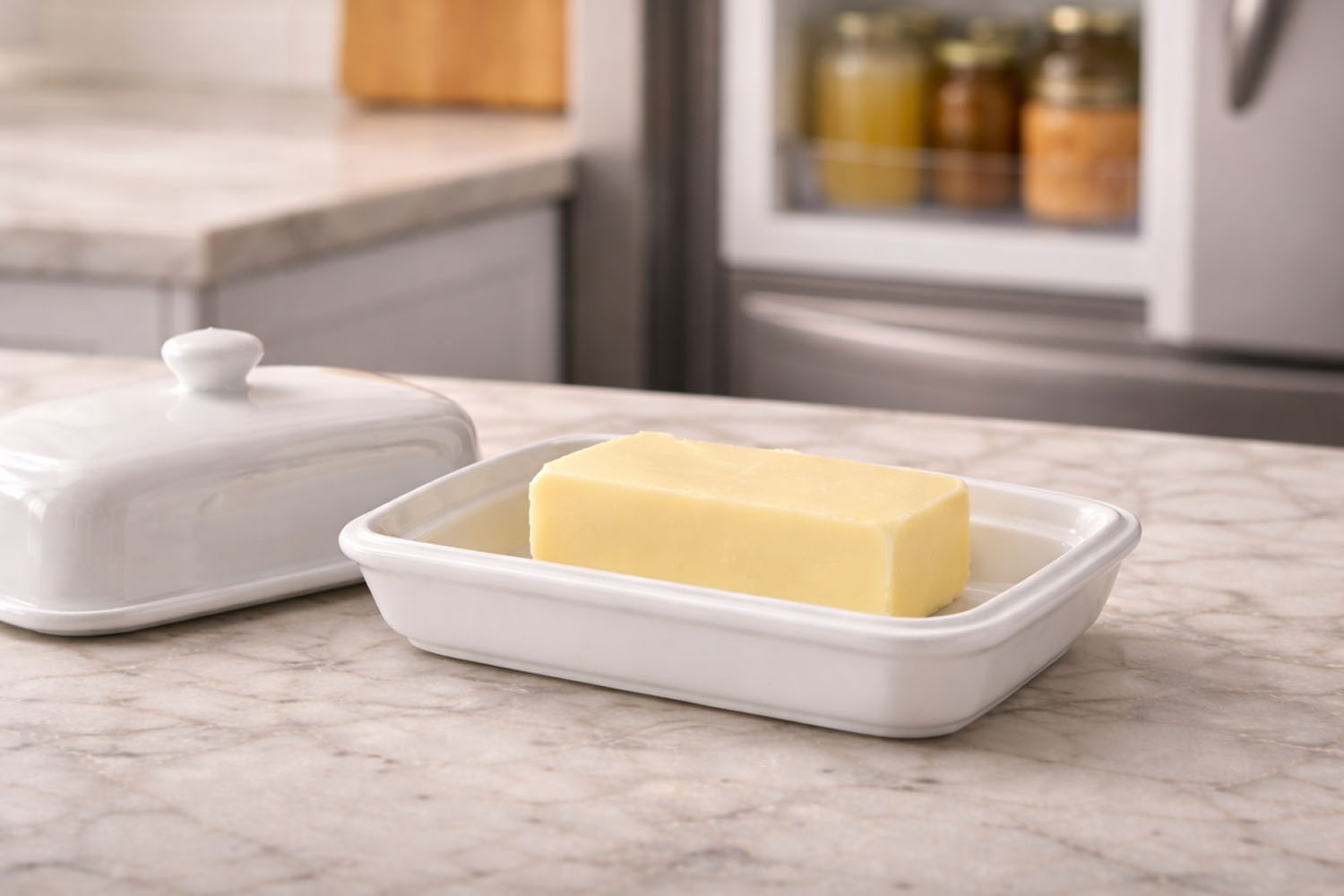
There it is on your counter: a stick of butter left out after breakfast. Now you are wondering if it needs to go back in the fridge or if it can stay. Does butter need to be refrigerated?
The short answer: Refrigeration is not strictly required for salted, pasteurized butter for short periods, but it is the safest and most practical choice for anything beyond a day or two. Unsalted, whipped, and flavored butters always belong in the refrigerator. And clarified butter and ghee need no refrigeration at all.
For a full overview of how dairy and pantry staples compare on storage needs, visit our Complete Food Storage Guide.
Key Takeaways
- Salted butter can sit on the counter in a covered dish for 1 to 2 days safely per USDA FoodKeeper guidance.
- Unsalted butter should always be refrigerated. It lacks the salt protection that makes counter storage viable.
- Whipped and flavored butters must be refrigerated. Always.
- Clarified butter and ghee do not require refrigeration and are shelf-stable for months at room temperature.
- For long-term storage, the freezer is the best option for all regular butter.
Why Butter Is Different from Other Dairy
Most dairy products are risky at room temperature because they are high in moisture and protein, two things bacteria need to grow. Butter is the exception. It is roughly 80% fat with very little water, which makes it far more resistant to bacterial growth than milk, cream, or cheese.
The FDA recognizes this difference. Pasteurized butter is not always classified as a time and temperature control food the way that raw meat or fresh dairy is, precisely because its low moisture content does not support most bacterial growth under normal conditions.
That said, butter does go rancid over time through oxidation, and salt significantly slows that process. The type of butter you have changes everything.
Refrigeration by Butter Type
| Butter Type | Refrigerate? | Counter Life | Fridge Life |
|---|---|---|---|
| Salted butter | Recommended; not strictly required short-term | 1 to 2 days (covered) | 1 to 3 months |
| Unsalted butter | Yes, always | Not recommended | Up to 1 month |
| Whipped or flavored butter | Always | No more than 2 hours | 1 to 2 weeks |
| Clarified butter / ghee | Not required | 3 to 6 months (airtight) | Up to 1 year |
The Counter Butter Debate, Settled
This is one of the most argued kitchen questions. Here is the honest answer.
The official guidance: The USDA FoodKeeper lists butter as safe at room temperature with a recommended window of 1 to 2 days. This is a conservative guideline that errs toward caution, which is appropriate for a federal safety standard.
The real-world picture: Salted, pasteurized butter kept in a covered dish in a cool kitchen (below 70 degrees F) has very low bacterial risk. This is why the practice of keeping a covered butter dish on the counter is standard in France, the UK, and much of Europe, and common among serious home bakers in the US who need soft butter readily available. The actual risk is flavor degradation from oxidation, not foodborne illness.
The practical rule: Use salted butter for counter storage. Keep only a small amount out at a time. Use a covered butter dish or crock. Refresh every 1 to 2 days from the fridge supply. Keep the dish clean. In summer or in warm kitchens above 70 degrees F, move it to the fridge.
Who should always refrigerate: Pregnant people, older adults, those with compromised immunity, and households with young children should keep all butter refrigerated and soften portions briefly before use. The risk from counter butter is low but not zero, and for vulnerable individuals, the fridge is the right call.
Why Unsalted Butter Always Needs the Fridge
Unsalted butter is used primarily in baking, where controlling salt levels matters. But that missing salt also means missing the primary preservative that makes salted butter reasonably safe on the counter.
Without the antimicrobial and water-reducing effects of salt, unsalted butter oxidizes faster, picks up off flavors more readily, and is more vulnerable at room temperature. Even in a cool kitchen, leaving unsalted butter out for more than a few hours is not good practice. If you need soft unsalted butter for baking, the right move is to take out what you need and let it sit at room temperature for 30 to 60 minutes, then return the rest to the fridge.
Clarified Butter and Ghee Do Not Need Refrigeration
Why Ghee Is Shelf-Stable
Clarified butter and ghee are made by heating regular butter until all the water evaporates and the milk solids are removed, leaving nearly pure butterfat. Removing the moisture and milk proteins eliminates the two components that drive spoilage in regular butter. The result is a fat that is genuinely shelf-stable at room temperature.
Store opened ghee in an airtight container in a cool, dark pantry for 3 to 6 months without any refrigeration. Refrigerating extends this to about a year, though it will solidify in the cold and need to come to room temperature before use. Always use a completely dry spoon when scooping ghee. Any moisture introduced into the jar is the one thing that can cause it to spoil prematurely.
How to Store Butter Properly
Storage Best Practices
Keep it wrapped. Butter absorbs refrigerator odors easily. Keep it in its original wrapper or transfer to an airtight container. The butter compartment on the fridge door is slightly warmer than the main cavity, which keeps it softer and more spreadable while still safely cold.
Keep it away from strong-smelling foods. Onions, garlic, fish, and leftovers with strong aromatics will flavor your butter through the packaging over time. Store it on a separate shelf or in the butter compartment.
Freeze for long-term storage. Butter freezes beautifully in its original packaging. Add a layer of foil over the wrapper to prevent freezer burn. Salted butter lasts up to 12 months frozen; unsalted 6 to 9 months. Thaw in the refrigerator overnight rather than at room temperature.
See also

For a counter butter dish: Use salted butter only, keep the dish covered, keep the dish clean between refills, and replenish every 1 to 2 days from your fridge supply. A French butter crock, which uses a small amount of water to create an airtight seal, is one of the best tools for keeping counter butter fresh.
Label frozen butter. All butter looks the same frozen. Write the date and type before it goes in the freezer.
Ready to Bake? Try These Recipes
Butter is the star ingredient in all of these. Fresh, properly stored butter makes a noticeable difference:
Frequently Asked Questions
I left butter out overnight. Is it still good?
For salted, pasteurized butter in a covered dish in a normal kitchen, one night is almost certainly fine. Check the smell and taste before using it. If it smells and tastes clean and buttery, use it. If it smells even faintly rancid or sour, replace it. For unsalted or whipped butter left out overnight, the safety risk is low but the flavor may have already declined enough to be noticeable. Use your senses and replace it if it seems off.
Does keeping butter in the fridge make it last longer?
Yes, significantly. The cold temperature slows oxidation, which is the main process that causes butter to go rancid. Salted butter lasts 1 to 3 months in the fridge versus days on the counter. The fridge also protects butter from the heat and light fluctuations in a kitchen that accelerate spoilage.
Can I soften butter quickly without leaving it out for hours?
Yes. Grate cold butter on a box grater, which dramatically increases surface area and softens it in minutes. Alternatively, cut it into small cubes and spread them on a plate. A rolling pin can also flatten and soften cold butter quickly. Microwave softening works but is risky since it is easy to partially melt rather than soften butter, which changes the texture for baking.
Why does European butter seem to keep better on the counter?
European-style butters typically have a higher fat content (82 to 86% vs. the US standard of 80%) and slightly lower moisture, which makes them marginally more stable. Many are also higher in salt. European kitchen culture also tends toward smaller, more frequently refreshed counter portions rather than leaving a full stick out for days. The combination of higher fat, consistent use, and covered storage explains why the practice works there without issues.
Further Reading
Better Living may earn commissions through affiliate links and may occasionally feature sponsored or partner content. If you make a purchase through our links, we may receive a small commission at no cost to you.