This guide covers 9 real haunted places within a few hours of Philadelphia, from a prison that held Al Capone to a Revolutionary War fort with the heaviest bombardment of the war. Every site is tied to documented history: a real death, a real historical event, or decades of consistent staff and visitor reports, not manufactured scares. You’ll find the address, drive time from Philly, ticket info, and what’s confirmed fact versus local legend at each one.
We checked hours, admission, and the historical record for every site below directly against the attractions themselves, historical societies, and news archives, rather than recycling it from other lists. One entry on this list, Pennhurst Asylum, involves real, documented abuse of a vulnerable population and remains controversial as a haunted attraction; we’ve noted that directly.
Quick Answer: 9 Haunted Day Trips From Philadelphia
- Eastern State Penitentiary (Philadelphia, in-city): the prison that allegedly haunted Al Capone himself
- Fort Mifflin (Philadelphia, in-city): a Revolutionary War fort that survived the war’s heaviest bombardment
- Grumblethorpe (Philadelphia, in-city): a British general’s own blood, still visible on the parlor floor
- Pennhurst Asylum (Spring City, PA, ~45 min): a former state institution with a documented history of real abuse
- Old Jail Museum (Jim Thorpe, PA, ~1.5–2 hrs): a handprint that survives every attempt to paint over it
- Logan Inn (New Hope, PA, ~1 hr): New Hope’s oldest inn, said to be haunted by Aaron Burr
- Devil’s Den & Triangular Field (Gettysburg, PA, ~2.5 hrs): the most photographed haunted spot on America’s bloodiest battlefield
- Emlen Physick Estate (Cape May, NJ, ~2.5 hrs): a Victorian mansion in the town paranormal researchers call the most haunted seaside resort in America
- Harpers Ferry (Harpers Ferry, WV, ~2.5–3 hrs): home to America’s oldest ghost tour, running since 1974
The list moves from closest to farthest, starting with three in-city Philadelphia sites and ending with the farthest day trip on the list, so you can pick based on how much driving you’re up for.
Eastern State Penitentiary
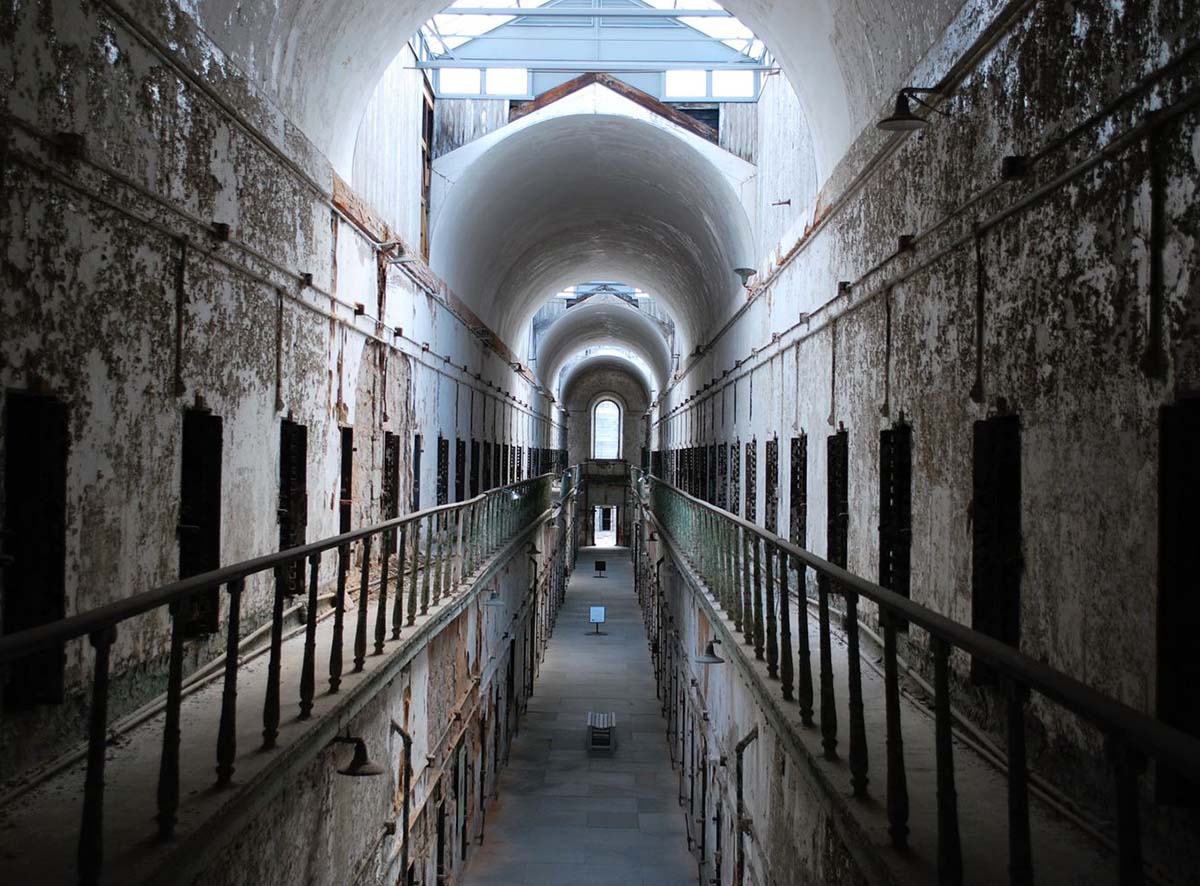
Al Capone spent eight months here in 1929, and by his own account, he wasn’t alone in his cell.
Opened in 1829, Eastern State Penitentiary pioneered the concept of solitary confinement as a form of moral reform and was, at the time, one of the most expensive and technologically advanced buildings in the country, with central heat and running water before the White House had either. It operated until 1971 and once held roughly 85,000 prisoners over its history, including bank robber Willie Sutton and, most famously, Al Capone, who served eight months there in 1929 for carrying a concealed weapon. According to widely repeated prison lore, Capone became convinced he was being haunted by the ghost of James “Jimmy” Clark, a rival gangster killed in the 1929 St. Valentine’s Day Massacre, and would scream at night for the presence to leave him alone. Visitors and paranormal investigation teams, including those from Ghost Hunters and Ghost Adventures, have reported disembodied voices, shadow figures, and cell doors that sound like they’re slamming even though many no longer physically move. Worth noting: Eastern State’s own museum staff have never officially claimed the site is haunted, even as it leans into the reputation every October with its Terror Behind the Walls haunted house.
Opened 1829Held Al CaponeNational Historic Landmark
Plan your visitIn Philadelphia’s Fairmount neighborhood, a short walk from the Philadelphia Museum of Art. Daytime self-guided and guided tours run year-round; general admission runs around $20 to $30. Terror Behind the Walls, the large-scale Halloween haunted house, runs select nights from September through early November and requires separate tickets that sell out well in advance.
👻👻👻👻👻 Haunt rating: maximum. Frequently called the most haunted site in Pennsylvania, and the building alone earns it.
Fort Mifflin
The fort that took the heaviest bombardment of the entire Revolutionary War, and Philadelphia police still get called out to it for a woman’s screams.
Commissioned in 1771 on the Delaware River, Fort Mifflin endured a brutal six-week siege in the fall of 1777, when British forces subjected it to what’s widely considered the heaviest bombardment of the Revolutionary War; more than half of the roughly 400 Colonial soldiers stationed there were killed or wounded in the fort’s last stand to protect Philadelphia. The fort saw further use as a Civil War-era military prison, where conditions were harsh enough that soldiers reportedly died of starvation and disease in its casemates. Its best-known ghost story involves a “Screaming Woman,” often identified as Elizabeth Pratt, the wife of a stationed U.S. Army sergeant, though accounts vary on exactly what tragedy befell her and her family. Philadelphia police have confirmed being dispatched to the fort multiple times in response to reports of a woman’s screams, with no one ever found on scene. Other reported figures include a “Faceless Man,” believed to be an executed deserter, and a friendly costumed tour guide who guests later learn was never actually on staff that day.
Commissioned 1771Heaviest siege of the RevolutionOldest active military site in the U.S.
Plan your visitNear Philadelphia International Airport, along the Delaware River. Daytime admission runs around $10 to $15, seasonal (closed in winter months, confirm before visiting). Candlelight ghost tours and overnight paranormal investigations run in October and can be booked separately.
👻👻👻👻👻 Haunt rating: maximum. Widely considered the most haunted single site in Philadelphia, with more documented reports than almost anywhere else on this list.
Grumblethorpe
A British general bled to death on this parlor floor in 1777. The stain is still there.
Built in 1744 as the summer home of German immigrant wine merchant John Wister, this stone house in Germantown was seized by British forces during their 1777 occupation of Philadelphia and used as a headquarters by Brigadier General James Agnew. On October 4, 1777, during the Battle of Germantown, Agnew was shot leading a counterattack and was carried back to the house, where he bled to death on the parlor floor; the bloodstain remains visible in the wood today. Staff at the house, now run as a museum by the Philadelphia Landmarks Preservation Trust, have described seeing a low, fast-moving black shape near the stain that has been witnessed independently by multiple people, including an education director and her son. A second reported presence is Justina, a Wister family servant believed to have died in Philadelphia’s 1793 yellow fever epidemic, whose appearances are sometimes accompanied by the smell of fresh-baked bread.
Built 1744Visible bloodstainBattle of Germantown site
👻👻👻👻 Haunt rating: high. A small, quiet house with an outsized, well-documented story.
Pennhurst Asylum
This site’s real history is more disturbing than any haunted-house scare, and that’s worth knowing before you go.
Pennhurst opened in 1908 as the Eastern Pennsylvania Institution for the Feeble-Minded and Epileptic, a state institution for people with intellectual and physical disabilities that, over nearly 80 years, became infamous for severe overcrowding, neglect, and documented physical and sexual abuse. A landmark 1968 television exposé by Philadelphia reporter Bill Baldini, followed by the 1974 federal lawsuit Halderman v. Pennhurst, brought national attention to the conditions and helped drive reforms in disability rights and institutional care nationwide. Pennhurst closed for good in 1987. Today, parts of the site operate as both the Pennhurst Museum, which documents this history for educational purposes, and a separately run haunted-house attraction, a pairing that has drawn real, ongoing criticism from disability advocates who argue it’s inappropriate to turn a site of documented real-world suffering into Halloween entertainment. We’re including it here because it’s one of the most significant and heavily documented sites of its kind in the country, but we’d encourage visiting the museum side with that history in mind, whichever attraction you choose to see.
Opened 1908Closed 1987Landmark disability rights case
👻👻👻 Haunt rating: moderate, and genuinely heavy. This one is about real history first, scares second.
Old Jail Museum
A convicted man pressed his hand to a cell wall claiming innocence before he was hanged. No amount of paint has ever fully covered it.
Built between 1869 and 1870, this stone jail served as the Carbon County Prison until 1995 and is best known as the site where several Irish-American coal miners known as the Molly Maguires were held and, on June 21, 1877, executed by hanging for the murders of two mine bosses, following trials that historians widely regard as biased against the defendants. In Cell 17, condemned man Alexander Campbell reportedly pressed his palm against the wall and declared his innocence shortly before his execution; a handprint said to be his has remained faintly visible ever since, surviving repeated attempts to wash, paint over, and even replaster the wall. The jail is listed on the National Register of Historic Places, and its labor-history angle, tied to the real conditions coal miners faced and the company-controlled courts that tried them, gives the ghost story an unusually well-documented backbone.
Built 1869–1870Cell 17 handprintNational Register listed
Plan your visitIn downtown Jim Thorpe, a scenic Poconos-area town worth a full day on its own. Guided tours run seasonally with limited days and hours, so check ahead, especially outside peak summer and fall months. Combine it with the town’s Old Jail Museum ghost walk and the Lehigh Gorge scenery if you’re making a full day of it.
👻👻👻👻 Haunt rating: high. The handprint alone is worth the drive, ghost story or not.
Logan Inn
Aaron Burr fled here after killing Alexander Hamilton, and some say he never really left.
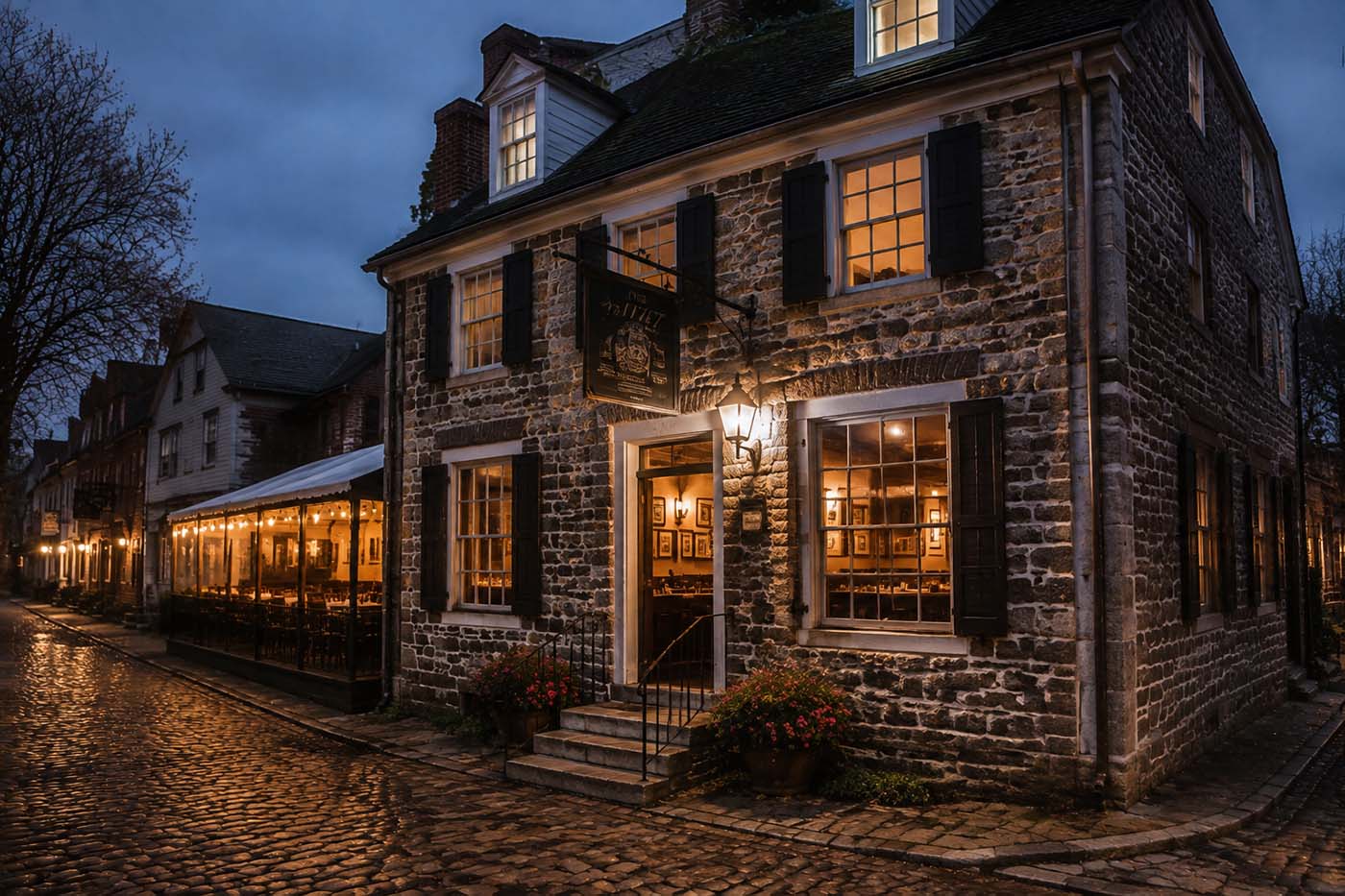
Established in 1727 as the Ferry Tavern by town founder John Wells, this inn was renamed the Logan Inn in 1828 in honor of Chief Logan of the Lenni-Lenape and is considered one of the oldest continuously operating inns in the country. George Washington’s troops passed through New Hope on their way to their 1778 winter encampment at Valley Forge, and the inn’s basement reportedly served as temporary storage for soldiers’ bodies awaiting proper burial when the ground was frozen too solid to dig. According to the New Hope Historical Society, the inn is, without question, the most haunted location in New Hope, with reported sightings of Revolutionary War-era soldiers and a persistent local legend tying the property to Aaron Burr, who fled to New Hope after his fatal 1804 duel with Alexander Hamilton; guests have described a sense of being watched, nicknamed “Burr’s sightless stare.” The inn was extensively renovated in 2021 and, despite two recent roof fires in November 2024 and October 2025, both accidental and both repaired within days, remains fully open and operating as of this writing.
Established 1727Aaron Burr legendNational Register listed
👻👻👻👻 Haunt rating: high. Local historians themselves call this the most haunted spot in a genuinely haunted-feeling town.
Devil’s Den & Triangular Field
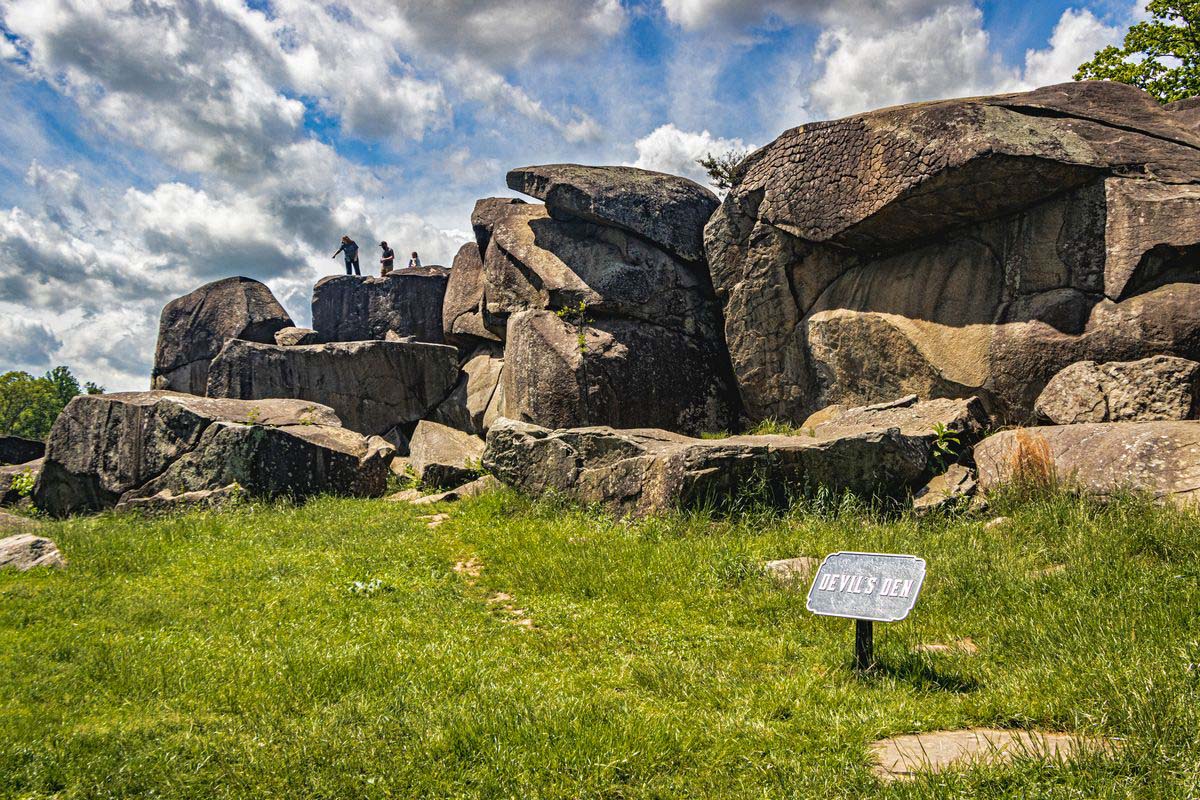
A famous Civil War photograph from this exact spot was staged. The reported hauntings, apparently, were not.
During the second day of the Battle of Gettysburg in July 1863, Union and Confederate soldiers fought at close range through this jumble of massive boulders and the open field just northwest of it, an area so brutal it later became known as the Slaughter Pen. Devil’s Den has its own documented historical controversy: renowned Civil War photographer Alexander Gardner and his assistant Timothy O’Sullivan are known to have moved a dead Confederate soldier’s body roughly 40 yards from where he actually fell on Devil’s Den’s southern slope to a more photogenic rock crevice nearby, propping a rifle beside him to stage one of the war’s most famous and most reproduced images, “Home of a Rebel Sharpshooter.” Visitors and paranormal researchers today report camera and electronic equipment consistently malfunctioning specifically within Triangular Field, apparitions of Confederate sharpshooters among the boulders, and phantom soldiers reported across the wider battlefield at spots like the Wheatfield, Little Round Top, and the aptly named Valley of Death. This is publicly accessible National Park Service land with no admission fee for daytime visits, distinguishing it from every other paid attraction on this list.
Battle of July 1863Free, public NPS landNo admission fee
Plan your visitPart of Gettysburg National Military Park; the battlefield closes at 10pm and reopens at 6am. Devil’s Den and Triangular Field are accessible via Sickles Avenue. Several licensed local companies run paid guided ghost tours after dark; several nearby haunted inns and taverns, including the Dobbin House Tavern, make good stops to pair with a battlefield visit.
👻👻👻👻👻 Haunt rating: maximum. Frequently cited as the single most documented paranormal site in the country.
See also

Emlen Physick Estate
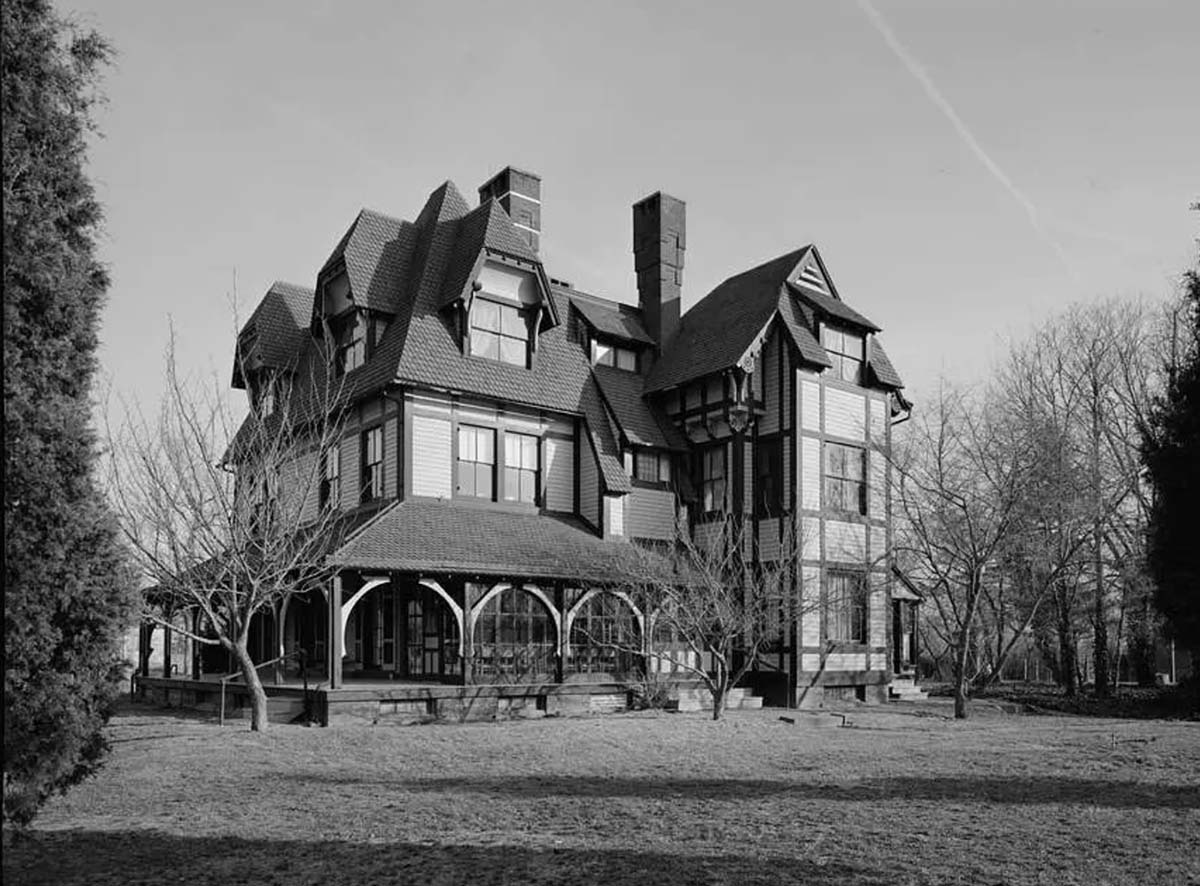
Cape May’s only Victorian house museum, and the family that built it is said to have never fully left.
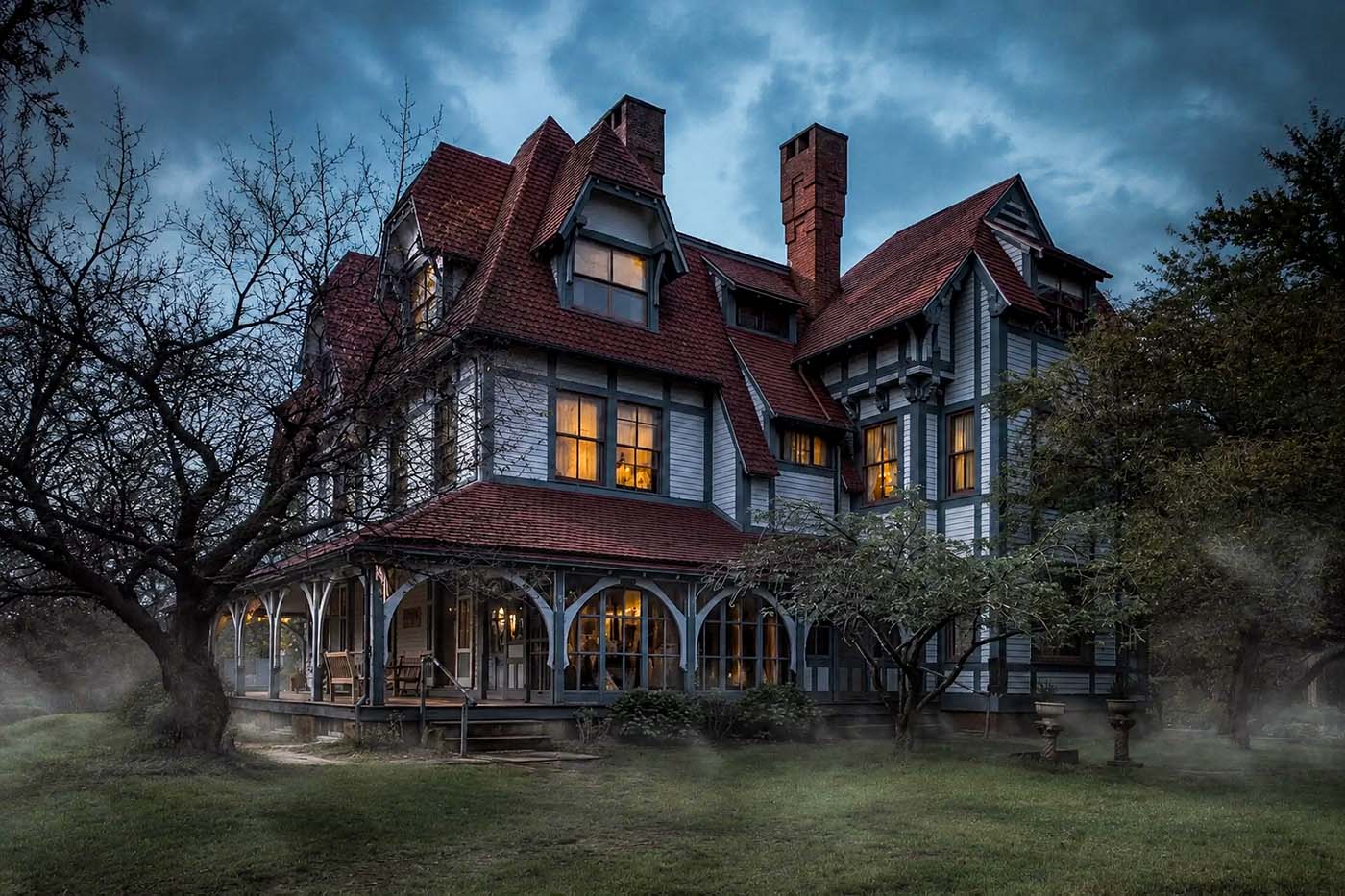
Designed by noted architect Frank Furness and built in 1879 for Dr. Emlen Physick, his mother Frances Ralston, and his aunt Emilie, this Stick Style Victorian mansion is the centerpiece of Cape May’s reputation as one of the most haunted seaside towns in America. Local paranormal researcher and author Craig McManus has spent years documenting the estate’s activity, and staff describe distinct presences tied to different family members, including Aunt Emilie, said to remain aware of everything happening in her former home. Reported phenomena include a woman in vintage clothing seen wandering the halls, cold and warm spots attributed to different residents, phantom dogs in the kitchen and gardens, and a recorded electronic voice phenomenon staff describe as a child’s voice. The estate, operated by the nonprofit Cape May MAC, runs its ghost tours as a legitimate blend of Victorian history and paranormal folklore rather than a jump-scare haunted house.
Built 1879Architect: Frank FurnessCape May’s original haunted house
Plan your visitIn the heart of Cape May’s historic district. Daytime house-museum tours run separately from evening ghost tours, which include the Voices From Beyond House Tour and a trolley-and-house combo tour; tickets generally run $20 to $30 and are worth booking ahead in October.
👻👻👻👻 Haunt rating: high. One of the better-documented, more respectfully run ghost tours on this list.
Harpers Ferry
A town that changed hands eight times during the Civil War, and America’s oldest ghost tour has been running here since 1974.
Sitting at the confluence of the Potomac and Shenandoah Rivers where Maryland, Virginia, and West Virginia meet, Harpers Ferry was the site of abolitionist John Brown’s failed 1859 raid on the federal armory, an attempt to seize weapons and spark a slave uprising that ended with Brown captured and several men, including two of his sons, killed. The town’s strategic position made it one of the most fought-over locations of the Civil War, changing hands between Union and Confederate forces eight separate times. Local ghost tour operators, running what’s billed as America’s oldest ghost tour since 1974, point visitors to sites including John Brown’s Fort, the Harper family home, and St. Peter’s Roman Catholic Church, where a long-serving priest is said to remain. One recurring story involves Brown’s own apparition, reportedly first reported in 1974, said to walk the town’s streets and converse with tourists who don’t realize who they’re talking to until he vanishes from their photos.
John Brown’s 1859 raidChanged hands 8 times in Civil WarGhost tour since 1974
Plan your visitHarpers Ferry National Historical Park is free to walk, though a small parking/entrance fee applies for vehicles. Given the drive time, this is the one entry on this list worth considering as an overnight rather than a same-day round trip, especially if pairing it with Appalachian Trail hiking. Ghost tours run seasonally and should be booked ahead.
👻👻👻👻 Haunt rating: high. The farthest drive on this list, but the depth of real history backing it up is hard to match.
Compare All 9 Before You Go
Read through all nine? Here’s how they stack up side by side.
FAQ
What’s the most haunted place near Philadelphia?
Fort Mifflin and Eastern State Penitentiary are the two names that come up most often among paranormal researchers, both widely cited as among the most haunted sites in Pennsylvania. Fort Mifflin has the deeper, more consistent documentation, including multiple confirmed calls to Philadelphia police over reported screaming, while Eastern State has the bigger name recognition thanks to Al Capone.
Can you visit these places without going on a haunted tour?
Yes, for most of them. Eastern State Penitentiary, Fort Mifflin, Grumblethorpe, the Old Jail Museum, the Emlen Physick Estate, and Devil’s Den all offer standard daytime historical tours completely separate from their evening ghost-focused programming, so you can visit purely for the history if that’s what you’re after.
Is it appropriate to visit Pennhurst Asylum as a haunted attraction?
That’s genuinely contested, and reasonable people land in different places on it. Pennhurst’s history involves real, documented abuse of people with disabilities, some of whom died there, and disability advocacy groups have publicly criticized turning the site into Halloween entertainment. The Pennhurst Museum, run separately from the haunted-house attraction, focuses specifically on education and preserving that history. If you visit, we’d encourage going in with that context rather than treating it purely as a scare.
Which of these can you visit for free?
Devil’s Den and Triangular Field, inside Gettysburg National Military Park, have no daytime admission fee since it’s public National Park Service land. Every other site on this list charges for tours or admission, though evening ghost tours are typically a separate, additional ticket from daytime museum or park access.
How far in advance should I book for October?
As early as you can, especially for Eastern State’s Terror Behind the Walls and Room 217-style room requests at nearby haunted inns. Halloween week is peak demand for nearly every ghost tour and haunted attraction on this list, and several sell out days or weeks ahead.
Better Living may earn commissions through affiliate links and may occasionally feature sponsored or partner content. If you make a purchase through our links, we may receive a small commission at no cost to you.