You pulled out the bag of all-purpose flour to make cookies and noticed the best-by date was six months ago. Or you have a half-open bag of almond flour you haven’t touched in a while. Either way, you’re wondering the same thing: does flour go bad?
The short answer: Yes, flour goes bad, but how quickly depends entirely on the type. White all-purpose flour lasts up to a year or more in a cool, dry pantry. Whole wheat flour can go rancid in as little as 3 months at room temperature. Almond and other nut-based flours are the most perishable, often lasting just 1 to 2 months at room temperature before the oils turn rancid. Spoilage signs are easy to catch if you know what to look for, and freezing can dramatically extend the life of any flour.
For a full overview of how pantry staples compare on shelf life, visit our Complete Food Storage Guide.
📋 Flour: At a Glance
- White all-purpose flour: 6 to 12 months pantry, up to 2 years frozen.
- Bread and self-rising flour: similar to all-purpose, 6 to 12 months pantry.
- Whole wheat flour: 3 months pantry, 6 months refrigerated, 12 months frozen.
- Almond and nut-based flours: 1 to 2 months pantry, up to 6 months refrigerated, 12 months frozen.
- Coconut flour: up to 6 months pantry (unopened), refrigerate or freeze after opening.
- Rancid flour smells off but is unlikely to make you sick. Moldy flour is a different story and should always be discarded.
- Raw flour is not safe to eat regardless of age. Always cook or bake flour fully before eating. Raw flour can carry E. coli and Salmonella.
Key Takeaways
- White flour lasts longest because the oil-rich bran and germ have been removed during milling, leaving a lower-fat product that resists rancidity.
- Whole wheat flour goes stale fastest because the germ and bran remain intact, and the oils they contain oxidize over time.
- Nut-based flours (almond, coconut) are the most perishable due to their high fat content. Refrigerate or freeze after opening.
- The main spoilage risk is rancidity, not bacterial growth. Rancid flour smells off and tastes bitter, but the bigger danger is mold, which can produce harmful mycotoxins.
- Raw flour is a food safety risk at any age due to potential E. coli and Salmonella contamination, per the FDA and CDC. Always cook or bake flour-based products fully.
- Freezing extends any flour’s life significantly and doesn’t harm baking performance when flour is brought to room temperature before use.
How Long Does Flour Last?
Flour’s shelf life is almost entirely determined by its fat content. Refined white flours have had the bran and germ stripped away, leaving mostly starch with very little oil to oxidize. Whole grain flours retain the germ and bran, which are rich in natural oils that go rancid over time. Nut-based flours like almond and coconut are essentially ground nuts, meaning they carry significant fat from the start.
| Flour Type | Pantry | Refrigerator | Freezer |
|---|---|---|---|
| White all-purpose flour | 6 to 12 months | 1 year | Up to 2 years |
| Bread flour | 6 to 12 months | 1 year | Up to 2 years |
| Self-rising flour | 6 to 12 months | 1 year | Up to 2 years |
| Whole wheat flour | 1 to 3 months | Up to 6 months | Up to 6 months |
| Almond flour | 1 to 2 months | 6 months | Up to 12 months |
| Coconut flour (opened) | 3 to 6 months | 6 to 12 months | Up to 12 months |
| Oat flour | 3 months | Up to 6 months | Up to 6 months |
| Gluten-free rice-based blends | 6 to 8 months | 1 year | Up to 2 years |
Shelf life estimates based on guidance from FDA flour safety guidance and King Arthur Baking. Always check for spoilage signs regardless of date. Best-by dates on flour packaging reflect quality, not safety, for white refined flours. Whole wheat and nut-based flours should be treated more conservatively.
Why Different Flours Spoil at Different Rates
The Oil Content Explanation
When wheat is milled into white all-purpose flour, the outer bran layer and the oil-rich germ are removed, leaving mostly starchy endosperm. Without the germ’s natural oils, white flour has very little fat to oxidize, which is why it stays fresh for up to a year at room temperature.
Whole wheat flour keeps the entire grain intact, including the germ. The germ contains unsaturated fatty acids that begin oxidizing on contact with air, heat, and light. This oxidation is what produces rancidity: the sharp, stale, or paint-like odor that indicates the fats have broken down. Whole wheat flour at room temperature in an open bag can show rancidity signs within weeks in a warm kitchen.
Almond flour and coconut flour are ground from high-fat ingredients, not grain. Almond flour is roughly 50% fat by weight, most of it unsaturated, based on USDA FoodData Central nutritional data for blanched almond flour. These oils oxidize even faster than the germ oils in whole wheat flour, which is why almond flour left on a pantry shelf for two or three months can smell distinctly off even when it looks fine.
The practical rule: the more processing a flour has undergone (and therefore the less original grain oil it retains), the longer it lasts at room temperature.
How to Tell If Flour Has Gone Bad
Spoilage Signs to Check Before You Bake
Smell it first. Fresh flour has a neutral, faintly wheaty aroma. White all-purpose flour may smell almost like nothing. Whole wheat and almond flour have a mild, pleasant nutty scent. If the flour smells sour, musty, bitter, or like old paint or crayons, it has gone rancid. This is the single most reliable test, especially for whole grain and nut-based flours where visual inspection is harder.
Look for discoloration. White flour should be a consistent pale cream color. Yellowing, gray patches, or dark specks that aren’t part of the grain indicate oxidation or moisture damage. According to King Arthur Baking, flour that looks yellow or gray or has developed hard moisture lumps should be discarded.
Check for mold. Any fuzzy growth, dark spots, or clumping with unusual color means discard immediately. Mold in flour can produce mycotoxins, compounds that can trigger vomiting, diarrhea, and in cases of prolonged exposure to high levels, more serious health effects, according to publicly available research. Rancid flour is unpleasant but unlikely to make you seriously ill. Moldy flour is a different category of risk entirely.
Look for insects. Flour weevils, flour beetles, and flour moths leave behind silk-like webbing, tiny larvae, and dark specks of frass (insect droppings). If you see any of these, discard the flour and thoroughly clean the storage container before refilling. Insects can penetrate sealed paper bags but cannot get into airtight hard-sided containers, which is why container storage matters.
For almond flour specifically: taste a small amount. King Arthur Baking recommends tasting almond flour directly. If it tastes mildly sweet and nutty, it’s fine. If it tastes bitter or has any off flavor, don’t use it.
The Raw Flour Safety Issue (Separate from Spoilage)
Raw Flour Is Not Safe to Eat at Any Age
This is worth stating clearly because it’s separate from the question of whether flour has gone bad. The FDA classifies flour as a raw agricultural product, similar to fresh produce. Grinding grain into flour does not kill harmful bacteria. Harmful bacteria including E. coli and Salmonella can contaminate grain in the field and survive the milling process.
The CDC has investigated outbreaks of foodborne illness linked to raw flour or cake mix in 2016, 2019, 2021, and 2023. These outbreaks resulted in known illnesses and hospitalizations. The recalled products in the 2019 outbreak included major brands like King Arthur and Pillsbury, which underscores that the risk is not limited to low-quality or off-brand flour.
The key point: do not eat raw dough or batter made with flour, do not let children play with raw dough, and do not try to heat-treat flour at home (home treatments may not reach temperatures sufficient to kill all pathogens). Baking and cooking flour at standard temperatures kills these bacteria. This applies to all flour regardless of age or brand.
How to Store Flour to Maximize Shelf Life
Storage Best Practices by Flour Type
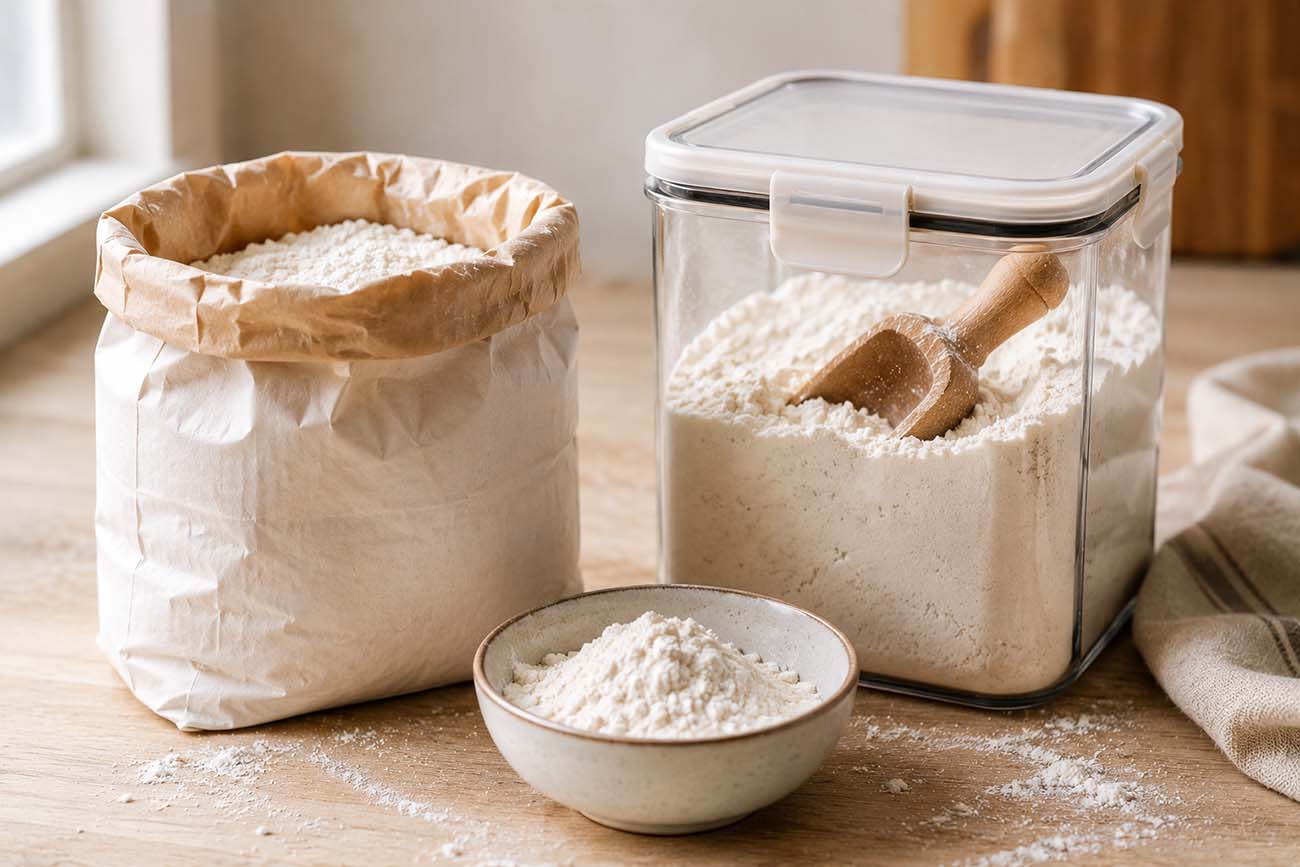
White all-purpose, bread, and self-rising flour: airtight container in a cool, dry pantry. Transfer from the paper bag immediately after opening. Paper bags allow moisture and pantry odors in. A hard-sided airtight container (glass, ceramic, or food-grade plastic with a tight seal) keeps out moisture, pests, and air. Store away from the stove, dishwasher, or any heat source. If your kitchen runs warm, the refrigerator or freezer is worth considering even for white flour.
Whole wheat flour: refrigerator or freezer from the start. Whole wheat flour deteriorates quickly at room temperature. For regular baking use, store in an airtight container in the refrigerator. For longer-term storage, freeze it. Bring to room temperature before measuring for baking to avoid affecting hydration and texture in your recipes.
Almond flour and coconut flour: refrigerate after opening, freeze for long-term. These flours should not be kept at room temperature after opening. Store in an airtight container in the refrigerator and use within 6 months. For larger quantities, freeze and portion out as needed.
Label your containers. Once flour is out of the original packaging, the best-by date is gone. Write the date you opened or transferred the flour on the container with a piece of tape or a marker.
Freeze larger quantities. Buying flour in bulk makes economic sense, but only if storage is right. Divide large bags into smaller airtight portions and freeze. White flour keeps in the freezer for up to 2 years with no quality loss. Bring to room temperature before using to avoid condensation in your batter or dough.
Does Flour Need to Be Refrigerated?
White all-purpose flour does not need to be refrigerated if stored in a cool, dry pantry in an airtight container. It is shelf-stable per USDA classification and will last up to a year under those conditions. Refrigeration extends its life to around a year and freezing to up to 2 years, but neither is required for routine use.
Whole wheat flour, almond flour, and coconut flour benefit significantly from refrigeration or freezing because of their higher oil content. For those flours, refrigeration is the better default rather than an optional upgrade. See our companion post Does Flour Need to Be Refrigerated? for the full breakdown by flour type.
Recipes That Use Flour
Frequently Asked Questions
Can I use flour past its best-by date?
Yes, white all-purpose flour is often perfectly usable well past its best-by date if it passes the smell and visual check. Best-by dates on white all-purpose flour are quality indicators, not safety cutoffs. White flour stored in a sealed, airtight container in a cool pantry is often usable months past the printed date. Whole wheat, almond, and other high-fat flours are less forgiving. For those, trust your nose over the date. If it smells rancid or off, don’t use it regardless of what the package says.
What does rancid flour smell like?
Rancid flour has a sharp, stale, or slightly chemical smell, often compared to old paint, crayons, or sour milk. Whole wheat flour that has gone rancid can smell musty or like wet cardboard. Almond flour that has turned will taste bitter even if the smell is subtle. If you’re not sure, compare a small amount to fresh flour of the same type: the difference is usually immediately obvious once you’ve experienced rancid flour once.
See also

Is it safe to bake with slightly rancid flour?
Mildly rancid white flour is unlikely to make you sick, but it will produce baked goods that taste off, flat, or slightly bitter. The quality loss is real even if the safety risk is low. Moldy flour is a different situation entirely and should always be discarded without exception. If you are baking for children, pregnant women, elderly individuals, or anyone with a compromised immune system, the safer call is to discard any flour that smells questionable rather than baking with it.
Can you freeze flour?
Yes, and freezing is one of the best ways to extend flour’s life without any quality loss. Transfer flour to a sealed freezer bag or airtight container before freezing. White all-purpose flour keeps up to 2 years in the freezer. Whole wheat, almond, and nut-based flours keep up to 12 months frozen. When ready to use, bring flour to room temperature before measuring and adding to recipes. Cold flour can affect how dough and batter come together, particularly in recipes that rely on precise hydration ratios.
Why does my flour have bugs in it?
Flour weevils and flour beetles can infest even recently purchased flour. Their eggs are sometimes present in grain before milling and can hatch at room temperature in a warm kitchen. Paper bags offer no protection against infestation once eggs are present. Storing flour in a hard-sided airtight container eliminates the conditions these insects need to thrive. If you find insects in flour, discard it, wash the container thoroughly with hot soapy water, dry completely, and refill with fresh flour. Check other nearby pantry items as well, since infestations can spread.
Does self-rising flour go bad faster than all-purpose?
Self-rising flour goes bad in two ways that all-purpose flour doesn’t. The flour itself has the same shelf life as white all-purpose flour, around 6 to 12 months. But self-rising flour contains baking powder, which loses its leavening power over time regardless of whether the flour itself has spoiled. Self-rising flour that smells and looks fine but is more than a year old may still produce flat, dense baked goods because the baking powder is no longer active. To test: stir a teaspoon into hot water. If it bubbles vigorously, it’s still active. If it barely reacts, the leavening is spent.
How long does almond flour last after opening?
Opened almond flour kept at room temperature lasts roughly 1 to 2 months before the oils begin to turn rancid. Refrigerated in an airtight container, it lasts up to 6 months. Frozen, it lasts up to 12 months. Because almond flour is sold in bags that often contain more than a single recipe’s worth, the practical recommendation is to refrigerate it as soon as you open it, or freeze a portion if you won’t use it within a few weeks. Taste a small amount before using: the bitterness of rancid almond flour is immediately detectable.
Can old flour make you sick?
Rancid flour is unlikely to cause serious illness, though it tastes bad and may cause mild stomach discomfort in large quantities. Moldy flour is a more serious concern because mold can produce mycotoxins, which can cause vomiting, diarrhea, and in cases of sustained high-level exposure, more serious health effects. Any flour with visible mold should be discarded. Separately, raw flour at any age can carry E. coli or Salmonella from field contamination. This is a safety issue independent of whether the flour has gone bad. Always fully cook or bake flour-based products before eating.
What’s the best container to store flour in?
A hard-sided airtight container made of glass, ceramic, or food-grade plastic is the best option. The container should seal tightly enough that it doesn’t let in air or moisture. Large flip-top glass jars or food storage canisters with rubber-sealed lids work well. Avoid leaving flour in its original paper or thin plastic bag, which cannot keep out moisture, pantry odors, or insects. For large quantities, a food-grade bucket with a gamma seal lid is a common choice for long-term storage. Whatever container you use, keep it in a cool, dry spot away from heat sources.
Does flour absorb odors from the pantry?
Yes, flour absorbs surrounding odors easily, particularly when stored in paper bags near strongly scented foods like onions, spices, or cleaning products. Flour stored near onions or garlic in an open paper bag can pick up those flavors and transfer them to your baked goods. An airtight container solves this completely. This is especially relevant for delicate recipes where the neutral flavor of flour matters, like macarons, shortbread, or vanilla-forward cakes.
Does whole wheat flour need to be refrigerated?
Refrigeration is strongly recommended for whole wheat flour, especially in warm kitchens. At room temperature, whole wheat flour can go rancid within 3 months. Refrigerating it in an airtight container extends freshness to around 6 months, and freezing takes it to 12 months. If you bake with whole wheat flour regularly, keeping a working supply in the refrigerator and a backup in the freezer is the most practical approach. Always bring refrigerated flour to room temperature before measuring for best results in baking.
How long is flour good after the expiration date?
White all-purpose flour is often good for 6 to 12 months past the printed best-by date if it has been stored properly in an airtight container in a cool pantry. The best-by date reflects optimal quality, not a safety deadline for white refined flour. Whole wheat flour is different: its higher oil content means it can go rancid before or around the best-by date if stored at room temperature, so treat the date as a firm guideline rather than a suggestion. Almond and other nut-based flours should also be used by or before the date. For any flour past its date, smell and visual inspection are the final word.
What can I do with expired flour?
If flour has gone rancid but shows no mold or insects, it still has several non-food uses. Add it to a compost bin (mix with green materials to help it break down). Sprinkle a line of flour as an ant deterrent, since ants won’t cross it. Use it to make homemade play dough or craft paste for children’s projects (rancid flour is fine for non-edible crafts). Flour that shows any mold or insect activity should go straight in the trash, sealed, rather than compost, to avoid spreading mold spores or pests.
Does oat flour go bad?
Yes, and relatively quickly. Oat flour is a whole grain flour, meaning it retains the oat’s natural oils. Like whole wheat flour, those oils oxidize over time and produce rancidity. Oat flour kept at room temperature in an open container can go rancid within 1 to 3 months. Store it in an airtight container in the refrigerator (up to 6 months) or freezer (up to 6 months) for best results. The smell test applies: fresh oat flour has a mild, pleasant oaty scent. Rancid oat flour smells musty or sour.
Further Reading
Better Living may earn commissions through affiliate links and may occasionally feature sponsored or partner content. If you make a purchase through our links, we may receive a small commission at no cost to you.