You open the pantry and find a can of Crisco that has been sitting there since last winter, or longer. The best-by date has passed and you are not sure whether it is still good. Does shortening go bad?
The short answer: Yes, shortening goes bad. The primary way it fails is through rancidity, a process where the fats oxidize and develop an off smell and bitter taste. According to Crisco’s official FAQ, vegetable shortening has a shelf life of 2 years unopened for both cans and sticks. Once opened, cans last about 1 year and sticks last about 6 months when stored properly in a cool, dry pantry. Rancid shortening will not make you acutely ill, but it will ruin the flavor of anything you bake with it and is not worth using. The smell and taste test are the definitive checks.
For a full overview of how baking staples compare on shelf life, visit our Complete Food Storage Guide.
📋 Shortening: At a Glance
- Unopened shortening (cans and sticks): 2 years from manufacture per Crisco’s official guidance.
- Opened cans: about 1 year when stored properly in a cool, dry pantry per Crisco.
- Opened sticks: about 6 months per Crisco.
- Rancidity is the main failure mode, not mold or bacterial spoilage. Rancid shortening smells like old paint or nail polish remover and tastes bitter.
- Refrigeration is not required but is acceptable. Crisco recommends pantry storage. Cold shortening becomes firmer and needs to come to room temperature before use.
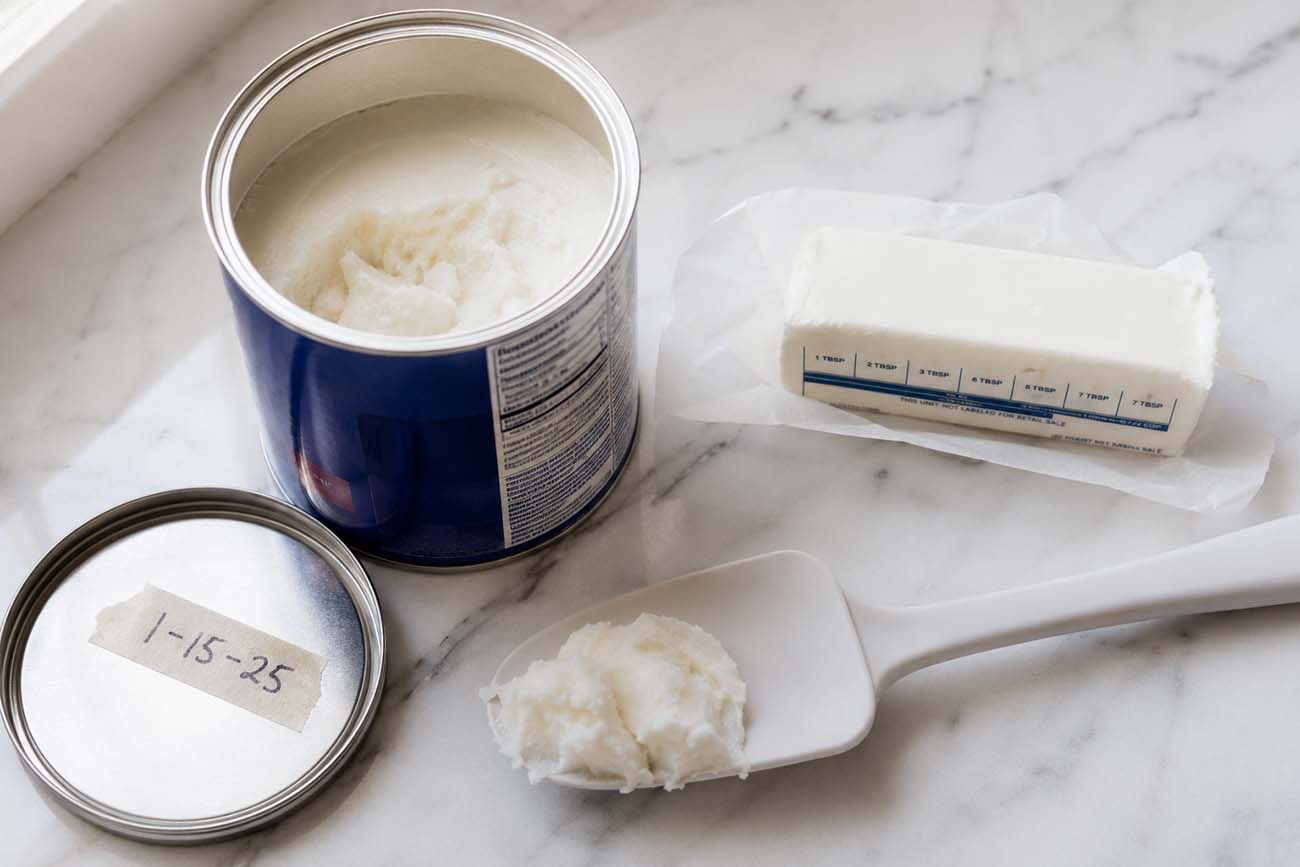
- Write the opening date on the container per Crisco’s freshness tip. This removes all guesswork.
Key Takeaways
- Shortening does go bad, unlike some other pantry staples. Sugar and cornstarch last indefinitely. Shortening does not. Its fat content is the variable.
- The Crisco FAQ is the primary source for shelf life guidance. Crisco recommends 2 years unopened, 1 year for opened cans, 6 months for opened sticks.
- Preservatives extend Crisco’s life significantly. Crisco contains BHT (butylated hydroxytoluene) and citric acid as antioxidants that slow the rancidification process. Unpreserved shortenings and lard have shorter shelf lives.
- The smell and taste tests are definitive. Fresh shortening is nearly odorless and neutral in flavor. Rancid shortening smells sharp and off and tastes bitter. Trust your senses over the date.
- Heat, light, and air are the three enemies. Storing shortening near the stove, in direct sunlight, or with a loose lid accelerates rancidity significantly.
- Rancid shortening will not cause acute illness in small amounts but will ruin the flavor of your baked goods and is not worth using.
How Long Does Shortening Last?
Shortening’s shelf life is controlled almost entirely by the rate of fat oxidation. Vegetable shortening is made from plant-based oils (typically soybean, palm, and cottonseed oils) that have been partially or fully hydrogenated to make them solid at room temperature. Hydrogenation increases stability compared to liquid oils, giving shortening its long shelf life, but the fats still oxidize over time when exposed to air, heat, and light.
| Shortening Type and Status | Pantry Shelf Life | Source |
|---|---|---|
| Crisco can (unopened) | 2 years from manufacture | Crisco official FAQ |
| Crisco sticks (unopened) | 2 years from manufacture | Crisco official FAQ |
| Crisco can (opened) | About 1 year | Crisco official FAQ |
| Crisco sticks (opened) | About 6 months | Crisco official FAQ |
| Lard (unopened) | About 1 year pantry; refrigerate after opening | USDA FSIS guidance |
| Butter Flavor Crisco (all formats) | Same as original Crisco | Crisco official FAQ |
Shelf life guidance per Crisco’s official FAQ and USDA FSIS shelf-stable food safety guidance. Crisco’s own guidance is the primary source for Crisco-brand products. Some sources cite a more conservative USDA general guideline for all vegetable shortenings (approximately 8 months sealed, 3 months opened), which does not account for Crisco’s specific preservative-enhanced formula. Always check for rancidity signs regardless of the date.
Why Shortening Goes Rancid: The Science
Oxidation and the Role of Preservatives
Rancidity occurs when the fatty acid chains in shortening react with oxygen in the air, producing compounds called aldehydes and ketones. These compounds are responsible for the sharp, stale, or paint-like smell and bitter taste that characterize rancid fat. The process is called lipid oxidation, and it accelerates with heat, light, and air exposure.
Crisco contains two antioxidant preservatives that significantly slow this process: BHT (butylated hydroxytoluene) and citric acid. BHT interrupts the oxidation chain reaction by donating hydrogen to free radicals before they can react with the fat molecules. Citric acid acts as a chelating agent, binding to metal ions that would otherwise catalyze oxidation. These preservatives are why Crisco has a longer shelf life than unpreserved shortenings and lard, which begins to go rancid faster without this chemical protection.
Hydrogenation also contributes to stability. By converting some of the unsaturated fatty acid bonds in the plant oils to saturated bonds, hydrogenation reduces the number of reactive sites available for oxidation. Fully hydrogenated fats are more stable than partially hydrogenated fats, which is why different shortening formulations have slightly different stability profiles. The current Crisco formula uses a blend of fully hydrogenated palm oil and soybean and palm oils.
The practical implication: keep shortening away from the three main accelerants of oxidation: heat, direct light, and air. A sealed can in a cool, dark pantry is the best possible environment for maximizing the shelf life Crisco’s preservatives provide.
How to Tell If Shortening Has Gone Bad
Signs of Rancid or Spoiled Shortening
Smell it first. Fresh shortening, including Crisco, has an almost neutral odor with only a very faint oily note. Rancid shortening smells sharp, stale, or chemical: descriptions commonly include old paint, nail polish remover, crayons, or a harsh soapy smell. Per Crisco’s own FAQ, any off odor is a sign the product should not be used. This is the most reliable single test.
Check the color. Fresh Crisco is white or very pale cream. Yellowing, darkening, or patches of gray or brown indicate oxidation has occurred. Per Crisco’s FAQ, any change in color or appearance is a signal the product is past its shelf life. A thin yellowed surface layer can sometimes be scraped away and the interior used if it smells and tastes normal, but significant discoloration throughout the container means discard.
Look at the texture. Fresh shortening has a smooth, creamy consistency. Separation, graininess, or a slick pool of oil on the surface indicate breakdown. Some texture change is normal from temperature fluctuations, but combined with off color or smell it confirms spoilage.
Taste a small amount. Rancid shortening tastes bitter, sharp, or distinctly unpleasant rather than neutral. If the smell passed but you are still unsure, a very small taste on the tip of a spoon confirms or rules out rancidity. Do not use shortening that tastes off in any recipe.
Check for mold. Mold in shortening is rare because it is a low-moisture, high-fat product that does not support mold growth easily. However, if any organic material has been introduced into the container, mold can develop. Any visible fuzzy growth means discard immediately.
When in doubt, discard. Per Crisco’s FAQ: if you notice any change in color, appearance, odor, or taste, do not use the product. A new can of shortening is inexpensive compared to a ruined batch of baked goods.
How to Store Shortening Properly
Storage Best Practices
Cool, dry, dark pantry away from heat sources. Crisco’s official FAQ specifies storing shortening away from strong odors, direct sunlight, and heat sources including stoves, dishwashers, and refrigerators (the exterior of a refrigerator generates heat). A cabinet on the opposite side of the kitchen from the stove and away from windows is the correct location.
Keep the lid tightly sealed after every use. Air exposure is a primary driver of oxidation. Every time the lid is left loose or the container is left open, oxidation accelerates. For sticks, wrap unused portions tightly in their original paper or plastic wrap and store in a zip-close bag.
Write the opening date on the container. Crisco’s FAQ specifically recommends this: write the date on the package when you first break the seal. With a 1-year window for cans and 6 months for sticks, knowing the opening date removes all guesswork.
Refrigeration is optional but acceptable. Crisco recommends pantry storage as first choice. The fridge is acceptable if you live in a warm climate or prefer the extra buffer. Cold shortening becomes firmer and needs to return to room temperature before use in most recipes. Allow it to sit on the counter for at least an hour before baking.
Freezing is an option for long-term storage. Crisco can be frozen. For sticks, wrap in their original paper and place in a freezer bag. For cans, seal tightly. Thaw in the refrigerator or at room temperature. Frozen and thawed shortening performs the same as fresh in baking.
Do not store near strong-smelling foods. Crisco’s FAQ lists strong odors as a specific storage concern. Shortening absorbs surrounding odors over time. Keep it away from onions, garlic, spices, and cleaning products.
Do not use a wet spoon. Unlike most of the baking cluster, moisture is not the primary enemy of shortening (rancidity is), but introducing water into the can can create pockets where mold growth is possible. Always use a dry spatula or spoon to scoop.
Shortening vs. Butter vs. Lard: Shelf Life Comparison
Understanding how shortening compares to the other solid fats in baking puts its shelf life in context.
Butter: must be refrigerated. Unsalted butter lasts about 1 month refrigerated and up to 9 months frozen per USDA guidance. Salted butter lasts slightly longer because salt slows rancidity. See our companion post Does Butter Go Bad? for the full breakdown.
Lard: shelf life is about 1 year unopened at room temperature but goes rancid faster than Crisco after opening because it contains no preservatives. USDA guidance recommends refrigerating lard after opening. Lard is an animal fat and has more unsaturated fatty acids than fully hydrogenated shortening, making it more vulnerable to oxidation.
Vegetable shortening (Crisco): the most shelf-stable of the three solid baking fats, with the longest pantry life thanks to hydrogenation and added preservatives. The trade-off is that Crisco has less flavor than butter or lard in baked goods.
Coconut oil: solid at room temperature like shortening and stable for 1 to 2 years at room temperature per most sources, without refrigeration, due to its very high saturated fat content. See our companion post Does Coconut Oil Go Bad? for details.
What Happens If You Bake with Rancid Shortening?
Baking with rancid shortening produces results that are noticeably off. The bitter, sharp flavor of oxidized fat passes directly into cookies, pie crusts, biscuits, and anything else you make with it. The rancid compounds do not bake out: heat does not neutralize or remove the off-flavor compounds produced by oxidation. If you use rancid shortening and the finished product tastes wrong, the shortening was the cause. Discard both the shortening and the baked goods.
Consuming small amounts of rancid shortening, such as a taste to test it, is unlikely to cause acute illness in most healthy adults. However, regular consumption of oxidized fats is not advisable. The off-flavor makes it impractical to eat in meaningful quantities.
Recipes That Use Shortening
Frequently Asked Questions
How do I know if shortening has gone bad?
Smell it and look at it. Fresh shortening has a nearly neutral odor and is white or pale cream in color. Rancid shortening smells sharp, stale, or chemical, often described as old paint, nail polish remover, or a harsh soapy smell. Yellow, gray, or brown discoloration indicates oxidation. Per Crisco’s official FAQ, any change in color, appearance, odor, or taste means the product should not be used. A small taste on the tip of a spoon confirms it if you are still unsure: rancid shortening tastes bitter.
See also

How long does Crisco last after opening?
About 1 year for opened cans and about 6 months for opened sticks, per Crisco’s official FAQ. These windows assume proper storage in a cool, dry pantry with the lid kept tightly closed. Heat, light, and air exposure will shorten the window. Write the opening date on the container the day you first use it so you always know where you stand.
Does shortening need to be refrigerated?
No. Crisco’s official FAQ recommends pantry storage rather than refrigeration. Refrigeration makes shortening firmer and harder to work with until it returns to room temperature. Refrigeration is acceptable if you live in a hot climate or want extra shelf life, but it is not required for safety. If refrigerated, allow shortening to come to room temperature before using in recipes where its soft consistency matters, such as creaming with sugar.
Can you use shortening past its expiration date?
Yes, if it passes the smell, color, and taste checks. The best-by date on shortening reflects optimal quality, not a hard safety deadline. Crisco stored properly often remains usable past its printed date, particularly if the can has not been opened. Check for rancidity signs each time: if it smells neutral and looks white or pale, it is likely still good. If it smells off or has yellowed, discard it regardless of the date.
Can you freeze shortening?
Yes. Crisco can be frozen to extend its shelf life. Wrap sticks in their original paper and place in a sealed freezer bag. For cans, seal tightly before freezing. Thaw in the refrigerator or at room temperature. Frozen and thawed shortening performs identically to fresh shortening in baking. Portioning before freezing makes it easier to thaw only what you need.
What does rancid shortening smell like?
Rancid shortening smells sharp, harsh, and distinctly chemical. Common descriptions include old paint, nail polish remover, crayons, or a stale soapy smell. The rancid compounds produced by fat oxidation are aldehydes and ketones, which have low odor thresholds meaning even small amounts are detectable. If you open a can of shortening and something smells immediately wrong compared to the neutral smell of fresh Crisco, trust that reaction and discard it.
Is rancid shortening dangerous to eat?
Rancid shortening in small amounts, such as a taste used to test it, is unlikely to cause acute illness in most healthy adults. However, baked goods made with rancid shortening will taste noticeably off, and eating meaningful quantities of oxidized fat regularly is not advisable. The practical reason to discard rancid shortening is flavor: the bitterness transfers directly into everything you bake and does not cook out. Discard both the rancid shortening and any food made with it.
Can I substitute butter for shortening?
Yes, in most recipes. Per Crisco’s own FAQ, shortening and butter can be substituted 1:1 by volume. The main differences: butter contains about 80% fat and 16 to 17% water, while shortening is 100% fat with no water. This means butter produces slightly different textures in baked goods: flatter, crispier cookies and less flaky pie crusts compared to shortening. Butter also adds a richer flavor that shortening does not provide. For most home bakers, the substitution works well. The shelf life consideration: if your shortening has gone rancid, butter is a direct replacement, but it must be refrigerated and used within a much shorter window.
What is shortening made of?
Vegetable shortening like Crisco is made from plant-based oils that have been partially or fully hydrogenated to make them solid at room temperature. The current Crisco formula uses a blend of soybean oil, fully hydrogenated palm oil, and palm oil. It also contains BHT (butylated hydroxytoluene) and citric acid as antioxidant preservatives that slow rancidification. Unlike butter or lard, it contains no water and no animal fats. Butter Flavor Crisco has the same base formula with added natural and artificial butter flavoring.
Why does shortening last longer than butter?
Shortening outlasts butter for three reasons. First, it contains no water: butter is about 16 to 17% water, which supports microbial growth that can cause butter to spoil. Second, shortening is hydrogenated, converting unsaturated fatty acids to more stable saturated bonds that resist oxidation better than the predominantly unsaturated fats in butter. Third, Crisco contains added preservatives (BHT and citric acid) that butter does not. These three factors together give Crisco a pantry shelf life of up to 2 years unopened versus butter’s 1 to 3 months refrigerated.
Can shortening be used after the best-by date?
Yes, often. The best-by date on Crisco reflects peak quality under ideal storage conditions, not a strict safety cutoff. Shortening stored properly in a sealed can in a cool, dark pantry often remains usable past its date, particularly if unopened. The smell, color, and taste checks are more reliable than the date: if the shortening smells neutral, looks white, and tastes bland, it is likely still good. If it smells off, has yellowed, or tastes bitter, discard it regardless of what the date says.
How do I read the date code on a Crisco can?
Crisco uses a manufacturing code rather than a simple calendar date on some packaging. Per Crisco’s FAQ, the code looks something like “4 122 420 0321” where the first digit represents the year of manufacture (4 = 2024, 3 = 2023, and so on), the next three digits represent the day of the year (122 = May 2nd), and the remaining digits indicate the production line and time. If your can shows a “Best If Used By” date in plain format (e.g., AUG 09 2026), that is the straightforward expiration guideline. If you see only the manufacturing code, add approximately 2 years to calculate the quality window for an unopened can.
Does shortening go bad faster if left uncovered?
Yes, significantly. Air is one of the three main drivers of fat oxidation alongside heat and light. Shortening left with a loose or missing lid accelerates rancidification because oxygen continuously reaches the fat surface. Crisco’s FAQ specifically cites keeping the lid tight as a key freshness measure. Even a few weeks of loose storage can reduce the effective shelf life of an opened can noticeably. Always reseal tightly after every use and write the opening date on the container.
Does store-brand shortening have the same shelf life as Crisco?
It depends on the formula. Crisco’s extended shelf life compared to the USDA general guideline for vegetable shortening is partly attributable to its specific preservative blend (BHT and citric acid). Store-brand shortenings may use different preservatives or none at all, which can result in a shorter shelf life. Check the ingredient label of your specific brand for preservative content. As a practical guideline, follow the best-by date on the package and apply the same smell, color, and taste tests regardless of brand.
Can you use shortening for frying?
Yes. Crisco’s FAQ confirms shortening can be used for frying. Its high smoke point (around 360°F for standard Crisco) and 100% fat composition make it effective for deep frying and pan frying. Shortening used for frying degrades faster than stored shortening because repeated high-heat exposure accelerates oxidation. Discard frying shortening after 8 to 10 uses or when it darkens significantly, develops a strong smell, or produces excessive foaming. Do not reuse shortening that has been used to fry fish or other strongly flavored foods for baking.
Further Reading
Better Living may earn commissions through affiliate links and may occasionally feature sponsored or partner content. If you make a purchase through our links, we may receive a small commission at no cost to you.