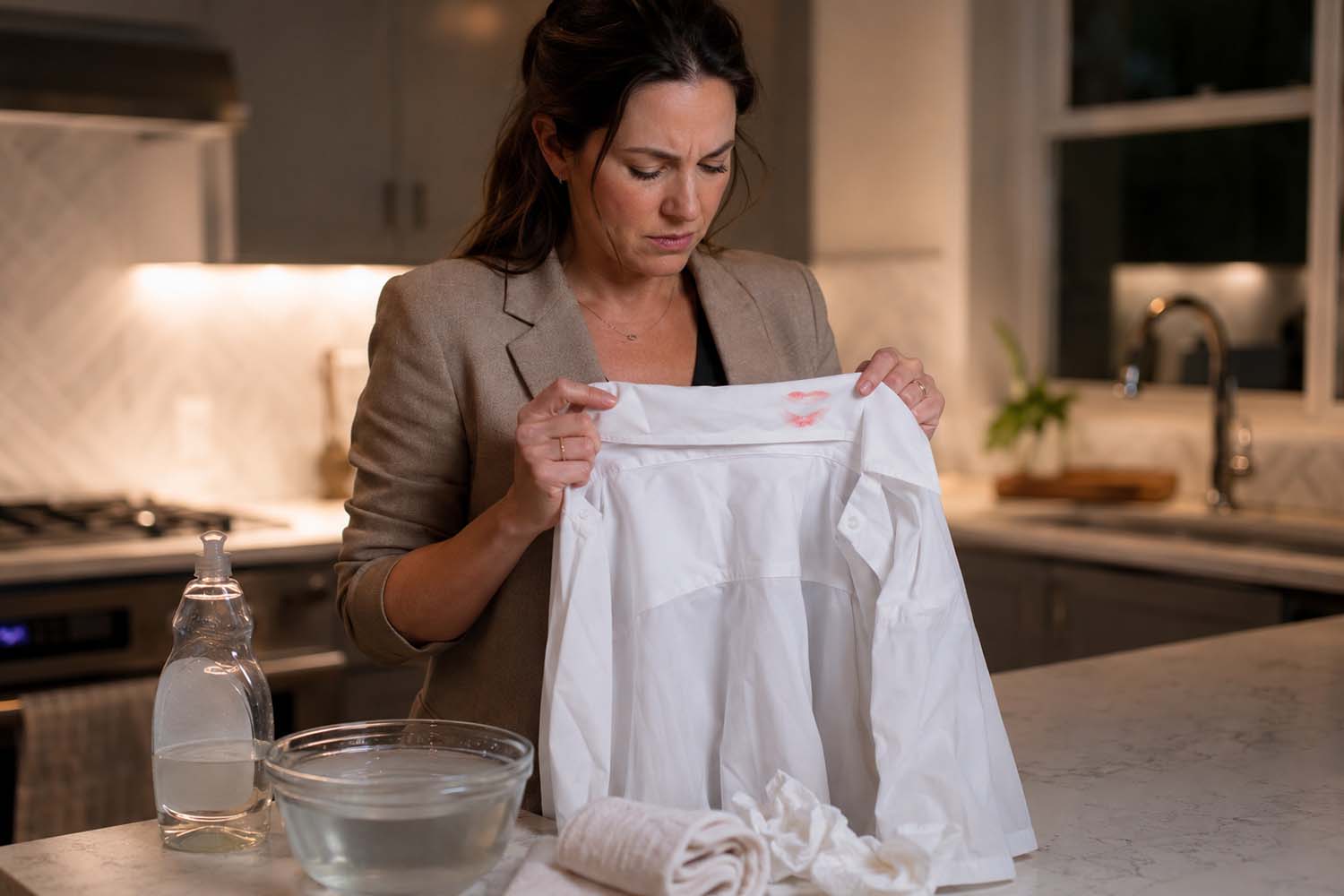
A coworker leaned in for a goodbye hug at a work dinner, aimed for my cheek, and landed half on my collar instead, leaving a perfect crimson smear on a white shirt I actually liked. In the restaurant bathroom, trying to fix it before anyone noticed, I rubbed it with a napkin dipped in hot water from the sink. By the time I got home an hour later, the stain had set into a permanent-looking shadow instead of fading. Hot water is exactly what does that to a lipstick stain, and I learned it the expensive way, standing in my kitchen at 11pm with a ruined collar and a strong opinion about dish soap.
The Short Answer: Lipstick stains are actually three stains layered together: wax, oil, and pigment. Scrape off the excess, treat with a solvent-based product or rubbing alcohol to break the wax and pigment, then follow with dish soap to lift the oil, and wash in cold or warm water only. Never use hot water until the stain is completely gone, since heat sets all three components into the fabric at once.
Why Lipstick Stains Are Different
Most stain guides treat lipstick like a single substance, the same way they’d treat coffee or grass. That’s why so many of them fail. Lipstick is a formulated product built from three separate ingredient categories, and each one behaves differently on fabric.
Wax, usually beeswax, carnauba wax, or candelilla wax, gives lipstick its structure and the slide that lets it glide on. Oil, which can be a plant-derived oil like jojoba or castor, or a petroleum derivative like mineral oil, keeps the formula moisturizing. Pigment, whether it’s a natural iron oxide or a synthetic dye, is what actually stains the fiber. A dish soap treatment alone will cut the oil but leave the wax and pigment behind. A solvent alone will break the wax but do nothing for a set-in oil stain. That’s why single-method advice so often leaves a ghost of the stain behind, even after a full wash cycle.
The Golden Rule
Treat lipstick as a wax stain first and an oil stain second. Every fast, effective removal method works because it breaks the wax and pigment loose before the oil ever gets a chance to bond deeper into the fiber. Reverse that order, or skip straight to a hot wash, and you’re far more likely to end up with a faint but permanent shadow instead of a clean shirt.
Stain Variants: What You’re Actually Dealing With
Fresh stains (still tacky, under an hour old) respond fastest to any method below. Scrape and treat immediately if you can.
Dried or set stains need a longer solvent soak, since the wax has had time to harden into the weave. Give the solvent step 10 to 15 minutes instead of 5.
Matte lipstick is higher in pigment and lower in oil, which oddly makes it easier to remove, since there’s less oil to chase.
Cream or glossy lipstick and lip gloss carry more oil and wax, and need the full three-step sequence every time.
Liquid lipstick uses polymer binders designed to be transfer-resistant on skin, which also makes it more transfer-resistant on fabric. It’s the most stubborn variant and often needs a second full treatment cycle before washing.
Method Cards
1
Dish Soap Method
Best for fresh, light stains on sturdy machine-washable fabrics. Scrape off excess lipstick with a dull knife, then apply a few drops of dish soap directly to the back of the stain. Let it sit 10 minutes, blot with a damp cloth, and rinse.
Verdict: Reliable for the oil component but weak on pigment alone. Best paired with the alcohol method below for anything past fresh.
2
Rubbing Alcohol Method
Best for pigment-heavy or dried stains on cotton, denim, and other sturdy fabrics. Dampen a cotton ball with isopropyl alcohol and dab, don’t rub, working from the outside of the stain in. Repeat with a fresh cotton ball until no more color transfers.
Verdict: The strongest option for breaking pigment loose. Skip on wool, silk, and acetate, since alcohol can damage those fibers.
3
Acetone (Nail Polish Remover) Method
Best for stubborn, dried, or liquid lipstick stains on cotton and polyester. Apply acetone-based nail polish remover to a cotton ball and dab the stain, then rinse thoroughly.
Verdict: Effective on the toughest formulas, but never use on acetate, triacetate, or modacrylic fabrics since acetone will dissolve those fibers outright. Always spot test first and check the care label.
4
Enzyme Pre-Treatment Method
Best as a finishing step before the wash, especially for stains that have already been through a scrape and solvent treatment. Apply an enzyme-based stain remover directly to the treated area and let it sit 15 to 30 minutes before washing.
Verdict: Won’t break down wax or pigment on its own, but it’s excellent insurance against the oil residue that solvent methods can leave behind.
Pro tip: Keep a Tide stain remover pen in your bag or car. Lipstick stains that get treated within the first 20 minutes come out dramatically easier than ones that sit through a car ride and a dinner. For the wash-day finishing step, an enzyme-based stain remover handles any oil residue the solvent methods leave behind. If you’re dealing with a stubborn or dried stain, this is also a good moment to check our foundation and makeup stain guide, since the fabric-care logic overlaps closely.
By Fabric Type
White cotton: The most forgiving fabric here. Any method above works, and chlorine bleach is safe as a last resort if the care label allows it.
Colored cotton: Skip chlorine bleach. Stick to dish soap, alcohol, or acetone, and always spot test in a hidden seam first.
Linen: Behaves like cotton but is more prone to yellowing from oxygen bleach. If you use an oxygen-based product, limit the soak to an hour and rinse thoroughly.
Polyester: Handles dish soap and acetone well. Avoid high heat at any stage, since polyester sets oil-based stains permanently faster than natural fibers.
Silk: Dry-clean only in almost every case. If you must spot-treat, use only diluted dish soap and blot gently. Skip alcohol and acetone entirely.
Wool: Never use alcohol, ammonia, chlorine bleach, or enzyme detergent on wool. A cold water dish soap blot is the safest home option, otherwise take it to a professional.
Denim: Sturdy enough for all four methods. Dried stains on denim often need the full sequence, since the tight weave holds pigment well.
Dry-clean-only fabrics: Don’t attempt any of these methods. Bring the garment to the cleaner as soon as possible, point out the exact stain location, and tell them it’s lipstick specifically, since that tells them which solvent to use and saves a redundant identification step.
Step-by-Step Protocol
- Check the care label first. If it says dry-clean only, stop here and take it to a professional.
- Use a dull knife or the edge of a credit card to gently scrape off any excess lipstick, working from the outside of the stain toward the center so you don’t spread it further.
- Lay the garment stain-side down on a clean towel or paper towel.
- Apply rubbing alcohol or acetone-based nail polish remover (fabric-appropriate, see above) to a cotton ball and dab the back of the stain, transferring the pigment onto the towel underneath.
- Switch to a clean section of towel as it picks up color, and keep dabbing until no more pigment transfers.
- Apply a few drops of dish soap directly to the remaining mark and let it sit for 10 minutes to break down any leftover oil.
- Rinse the area thoroughly with cool or lukewarm water.
- Apply an enzyme-based stain remover to the area as insurance and let it sit 15 to 30 minutes.
- Wash on the coldest setting the care label allows, and check the stain before it goes anywhere near a dryer. Heat will set any trace that’s left.
Never do this:
- Never use hot water on a lipstick stain before it’s fully removed. Heat sets the wax and pigment permanently.
- Never put the garment in the dryer until you’ve confirmed in good light that the stain is completely gone.
- Never use acetone on acetate, triacetate, or modacrylic fabrics. It will dissolve the fibers.
- Never use alcohol, ammonia, chlorine bleach, or enzyme detergent on wool.
- Never rub a fresh stain. Rubbing drives pigment and wax deeper into the weave instead of lifting it out.
- Never skip the spot test on a new fabric or a favorite garment. Solvents and dish soap can affect dye in unpredictable ways.
What Doesn’t Work
Hairspray is the most repeated piece of lipstick stain advice online, and it’s mostly outdated. The advice worked historically because older formulas were higher in alcohol, and alcohol is the ingredient that actually breaks down pigment. Most modern formulas have cut alcohol content significantly in favor of film-forming polymers and resins, so spraying today’s hairspray on a stain is likely to do very little beyond adding a sticky residue you then have to wash out anyway. Skip it and use rubbing alcohol directly instead, since that’s the ingredient that was doing the work all along.
Toothpaste is another common suggestion that oversells its own results. It can offer very mild abrasive lifting on fresh, light stains, but it does nothing for the wax or pigment components and often leaves a chalky residue that needs its own rinse cycle.
Distilled white vinegar shows up often as a natural alternative. It has a mild acidic effect that can loosen some pigment, but it’s noticeably weaker than dish soap or alcohol on real lipstick stains and works best as a light second pass rather than a primary method.
The One Thing I Wish I’d Known Sooner
I used to think lipstick was just a tough version of a regular stain, something you throw more product at until it gives up. What actually changed the outcome was realizing it’s three different problems stacked on top of each other, and that the order you attack them in matters as much as the products themselves. Wax and pigment first, oil second, heat never until it’s gone. That sequence is the whole trick.
Final Thoughts
Lipstick stains have a bad reputation, but they’re genuinely manageable once you stop treating them like a single substance. If you’re dealing with makeup stains more broadly, our foundation stain guide covers a lot of the same fabric logic. And if the stain in question is actually more of a sunscreen streak from a summer event, our sunscreen stain guide walks through that separately, since the chemistry is different.
Frequently Asked Questions
Does hairspray remove lipstick stains? Modern silicone-based hairsprays do very little. Older alcohol-based formulas worked because of the alcohol content, so using rubbing alcohol directly is more reliable today.
Can you get lipstick out of clothes after it’s been washed and dried? Yes, though it takes more effort. Repeat the solvent and dish soap steps, letting the solvent sit longer since heat from the dryer has likely set the stain further.
Does toothpaste remove lipstick stains? Only mildly, and only on fresh, light stains. It doesn’t address the wax or pigment components and isn’t a reliable primary method.
Is lipstick a grease stain or a pigment stain? Both. It’s built from wax, oil, and pigment together, which is why single-method advice so often leaves a faint mark behind.
What removes lipstick from silk? Diluted dish soap applied gently is the safest home option. For anything beyond a light mark, take silk to a professional cleaner rather than risk the fiber.
See also
Can you use nail polish remover on lipstick stains? Yes, on cotton, denim, and polyester, but never on acetate, triacetate, or modacrylic fabrics, since acetone dissolves those fibers.
Why does lipstick stain worse than other makeup? Its wax content is higher than most other makeup products, and wax bonds to fabric fibers more stubbornly than oil or pigment alone.
Is liquid lipstick harder to remove than regular lipstick? Generally yes. Liquid lipstick uses transfer-resistant polymer binders designed to stay put on skin, which makes it more resistant to removal from fabric as well.
Better Living may earn commissions through affiliate links and may occasionally feature sponsored or partner content. If you make a purchase through our links, we may receive a small commission at no cost to you.