You brought home a bag of cucumbers and are not sure whether they go in the fridge or on the counter. You know from experience that they tend to go mushy or develop soft spots before you finish them. The issue is almost always the same: cucumbers are one of the most temperature-sensitive vegetables in your kitchen, and standard refrigerator storage actively damages them.
The short answer: Store whole cucumbers wrapped in a paper towel inside a sealed zip-top bag in the warmest part of your refrigerator: the door or front of an upper shelf. This keeps them crisp for 7 to 10 days. Do not wash them before storing. Keep them away from tomatoes, apples, and bananas. Cut cucumbers go in an airtight container in the fridge and last 3 to 5 days.
For a complete reference on storing over 100 foods, see our Food Storage Guide.
Key Takeaways
- Whole cucumbers: paper towel wrap, zip-top bag, warmest part of fridge, 7 to 10 days
- Do not wash cucumbers before storing: moisture causes decay
- Optimal temperature: 50 to 55°F, which is warmer than most refrigerators run
- Chilling injury below 50°F develops in as little as 2 to 3 days: pitting, water-soaking, mushy flesh
- Keep away from tomatoes, apples, bananas, and melons: ethylene accelerates spoilage
- Cut cucumber: airtight container, fridge, 3 to 5 days
- English and Persian cucumbers: more delicate, shorter shelf life than standard slicing varieties
- Never freeze raw cucumber: texture becomes waterlogged and unusable
Why Cucumbers Go Mushy in the Fridge
The culprit is chilling injury, not bacteria or aging. Chilling injury is physiological damage that occurs in cucumbers when they are stored below 50 degrees Fahrenheit for more than 2 to 3 days. Standard home refrigerators run between 35 and 38 degrees Fahrenheit, well below that threshold.
At refrigerator temperatures, cucumbers suffer damage at the cellular level. The result is water-soaked spots, surface pitting, shriveling, and accelerated decay. Critically, this damage is irreversible. A cucumber that has suffered chilling injury will not recover when brought back to room temperature. In fact, according to the Cornell Cooperative Extension and WFLO Commodity Storage Manual, chilling symptoms develop most rapidly at higher temperatures after low-temperature storage. This explains the familiar pattern: the cucumber seems fine for a day or two in the fridge, then rapidly deteriorates.
The fix is not to avoid the refrigerator entirely. It is to store cucumbers in the warmest part of the refrigerator and to wrap them properly to minimize moisture exposure.
The Best Way to Store Whole Cucumbers
The paper towel method is the most effective approach for whole cucumbers, confirmed by UC Davis Post-Harvest Technology research and validated by real-world testing across nine different storage methods.
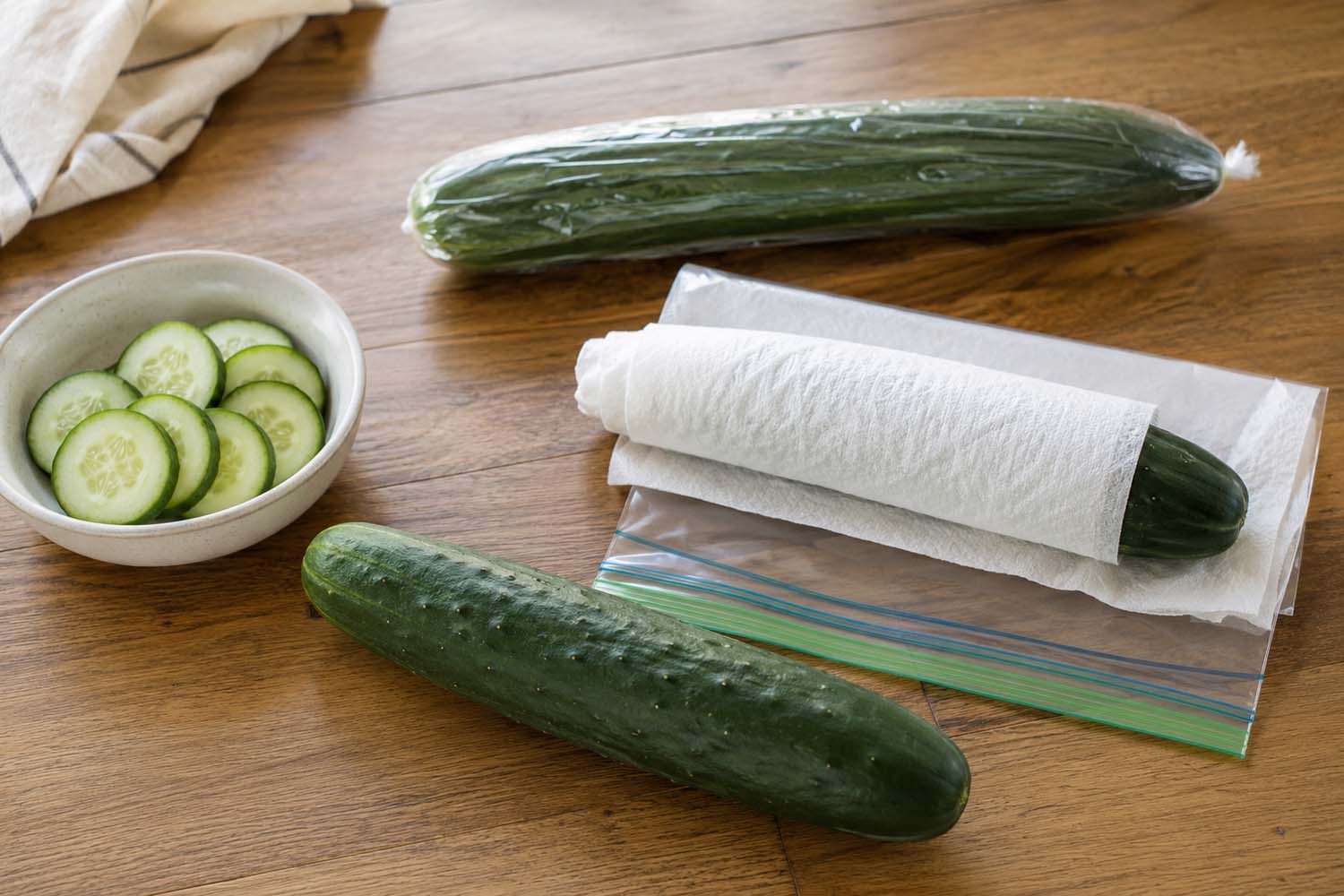
Wrap each cucumber individually in a dry paper towel. Place the wrapped cucumbers together in a zip-top bag and seal it. Store the bag in the warmest part of your refrigerator: the door or the front of an upper shelf, away from the back wall where cooling elements run coldest. Stored this way, cucumbers stay crisp for 7 to 10 days, and very fresh cucumbers can last up to 2 weeks.
The paper towel serves two functions. It absorbs condensation that inevitably builds up inside the sealed bag, preventing the moisture from sitting against the cucumber skin and accelerating decay. It also creates a slight buffer against the cold air directly contacting the skin. Together, these effects significantly extend freshness compared to placing unwrapped cucumbers in the crisper drawer.
Do not wash cucumbers before storing. Water on the skin dramatically accelerates mold and decay. Wash them immediately before cutting or eating, not before refrigerating.
Counter Storage: Only for a Day or Two
Whole cucumbers can sit at room temperature for 1 to 2 days without significant quality loss, and this actually avoids chilling injury entirely. If you plan to use the cucumber the same day or the next day, the counter is a reasonable option. Keep them away from direct sunlight and heat sources at all times.
Beyond 2 days at room temperature, cucumbers yellow, soften, and become bitter as they continue to ripen. For anything beyond immediate use, the refrigerator with the paper towel method is the better choice. Room temperature storage is not suitable for English or Persian cucumbers, which have thinner skins and lose moisture and quality much faster than standard slicing varieties. One note if you grow cucumbers in a garden: homegrown cucumbers have no wax coating, unlike most grocery store cucumbers which are waxed after harvest to retain moisture. Unwaxed garden cucumbers deteriorate faster at room temperature and generally benefit from refrigeration sooner. Slice them into a Greek salad feta dip or use them fresh the day of picking for the best results.
The Ethylene Problem: Keep Cucumbers Away From These Foods
Cucumbers are highly sensitive to ethylene gas, the natural ripening hormone produced by many fruits and vegetables. Ethylene exposure accelerates yellowing, softening, and decay in cucumbers significantly. According to Cornell Cooperative Extension, cucumbers should be stored away from high-ethylene producers at all times.
Keep cucumbers physically separated from tomatoes, apples, bananas, melons, and pears. This applies whether on the counter or in the refrigerator. A bowl of tomatoes sitting next to cucumbers on the counter will shorten the cucumber’s life noticeably. In the fridge, keep them on a different shelf or in a separate drawer from high-ethylene produce. For more on how tomatoes and ethylene interact with other produce, see Do Tomatoes Go Bad?
How to Store Cut Cucumbers
Cut cucumbers must go into the refrigerator immediately. The USDA two-hour rule applies: cut produce left at room temperature for more than two hours should be refrigerated or discarded. Place cut cucumber slices, spears, or chunks in an airtight container and refrigerate. Use within 3 to 5 days.
For sliced cucumbers specifically, an alternative method is to store them submerged in cold water in a sealed container, changing the water every 2 to 3 days. The water prevents moisture loss from the cut surface and keeps slices crisp longer than dry airtight storage. This works particularly well when prepping ahead for salads or snacking.
For halved cucumbers, press plastic wrap directly onto the cut surface before placing in an airtight container. This limits air exposure at the cut face and slows oxidation and moisture loss. Cut cucumbers stored loosely in an open bowl in the fridge dry out at the cut surface and absorb surrounding odors quickly. If you have an excess of cucumbers, refrigerator pickles and relish are the best way to use them up before they turn. Cucumbers also work beautifully in rainbow spring rolls and on a Greek meze board alongside fresh vegetables and dips.
English and Persian Cucumbers: Handle With More Care
English cucumbers (the long, thin, plastic-wrapped variety) and Persian cucumbers (the shorter, narrow variety sold in multi-packs) have significantly thinner, more delicate skins than standard American slicing cucumbers. This makes them more susceptible to chilling injury, moisture loss, and physical damage.
English cucumbers are typically sold shrink-wrapped in plastic. The manufacturer’s packaging provides the best moisture protection during transport and retail display. Keep the plastic sleeve on until you are ready to use the cucumber. It functions the same way the paper towel method does. Once opened, wrap the unused portion tightly in plastic wrap and store in the warmest part of the fridge. Use within 3 to 5 days of opening.
Persian cucumbers follow the same paper towel and zip-top bag method as standard cucumbers but with a shorter usable window. Plan on 5 to 7 days rather than 10.
See also

How to Tell If a Cucumber Has Gone Bad
Signs a Cucumber Has Gone Bad
- Soft or mushy spots: Fresh cucumbers are firm throughout. Soft patches anywhere on the skin indicate either chilling injury or bacterial decay. Discard if the soft area is large or extends through the flesh.
- Surface pitting: Small indentations or pockmarks on the skin are the classic sign of chilling injury. A lightly pitted cucumber is still edible if the flesh underneath is firm and green. Extensive pitting with soft flesh means discard.
- Water-soaked or translucent flesh: When cut open, the flesh should be bright, firm, and white to pale green. Translucent, waterlogged-looking flesh indicates chilling injury or advanced decay.
- Visible mold: Any fuzzy growth on the skin means discard the whole cucumber.
- Slimy skin: A slimy or tacky exterior indicates bacterial decay. Discard.
- Yellow skin: Yellowing is a sign of over-ripening from ethylene exposure or age. A slightly yellow cucumber is still edible but past its best. Extensively yellow flesh is bitter and unpleasant.
- Bitter taste: Cucumbers produce cucurbitacin when stressed by heat, drought, or over-ripening. A bitter taste is not a safety concern but indicates the cucumber is past its prime.
Storage Best Practices Summary
- Wrap whole cucumbers individually in dry paper towels before refrigerating
- Store in a sealed zip-top bag in the door or front of an upper refrigerator shelf
- Do not wash before storing; wash immediately before use
- Keep separated from tomatoes, apples, bananas, and melons
- Store cut cucumbers in an airtight container; use within 3 to 5 days
- Keep English cucumber plastic sleeve on until ready to use
- Do not freeze raw cucumber
Further Reading
How to Store Cucumbers FAQ
Should cucumbers be refrigerated?
Yes, with the right method. Cucumbers kept at standard refrigerator temperatures (35 to 38°F) develop chilling injury within 2 to 3 days. However, properly wrapped in a paper towel and stored in the warmest part of the fridge (the door or front of an upper shelf, closer to 50°F), they last 7 to 10 days without significant damage. The refrigerator is better than the counter for anything beyond 1 to 2 days of storage, as long as you use the paper towel method and avoid the coldest zones.
How long do cucumbers last in the fridge?
Whole cucumbers stored with the paper towel method in the warmest part of the fridge last 7 to 10 days, and very fresh cucumbers can last up to 2 weeks. Standard crisper drawer storage without wrapping typically produces cucumbers that last only 3 to 5 days before chilling injury becomes apparent. English and Persian cucumbers last 5 to 7 days with proper wrapping. Cut cucumbers in an airtight container last 3 to 5 days.
Can you freeze cucumbers?
Not for eating raw. Cucumbers have very high water content, and freezing ruptures cell walls and creates a waterlogged, mushy texture after thawing that is not suitable for fresh eating. However, if you want to preserve cucumbers for smoothies or infused water, freezing cucumber slices works reasonably well since the texture is irrelevant in those applications. Slice, spread on a baking sheet, freeze until solid, then transfer to a freezer bag. Do not try to thaw and use frozen cucumber in salads or as a fresh snack.
Why does my cucumber taste bitter?
Bitterness in cucumbers comes from compounds called cucurbitacins, which the plant produces in response to stress from heat, drought, inconsistent watering, or over-ripening. It is more common in garden cucumbers than grocery store varieties, which are bred to minimize cucurbitacin production. The bitterness is most concentrated near the stem end and in the skin. Peeling the cucumber and slicing off an inch from the stem end usually removes most of the bitterness. A bitter cucumber is not unsafe to eat, just unpleasant.
Why is my cucumber yellow?
Yellowing in cucumbers is caused by ethylene gas exposure or over-ripening. Cucumbers are highly sensitive to ethylene, which is produced by tomatoes, apples, bananas, melons, and other fruits. Prolonged storage near these producers causes cucumbers to yellow faster than their natural timeline. Yellowing can also occur when cucumbers are stored too warm for too long. A slightly yellow cucumber is still edible but will be softer and more bitter than a green one. Extensively yellow cucumbers should be discarded.
Better Living may earn commissions through affiliate links and may occasionally feature sponsored or partner content. If you make a purchase through our links, we may receive a small commission at no cost to you.