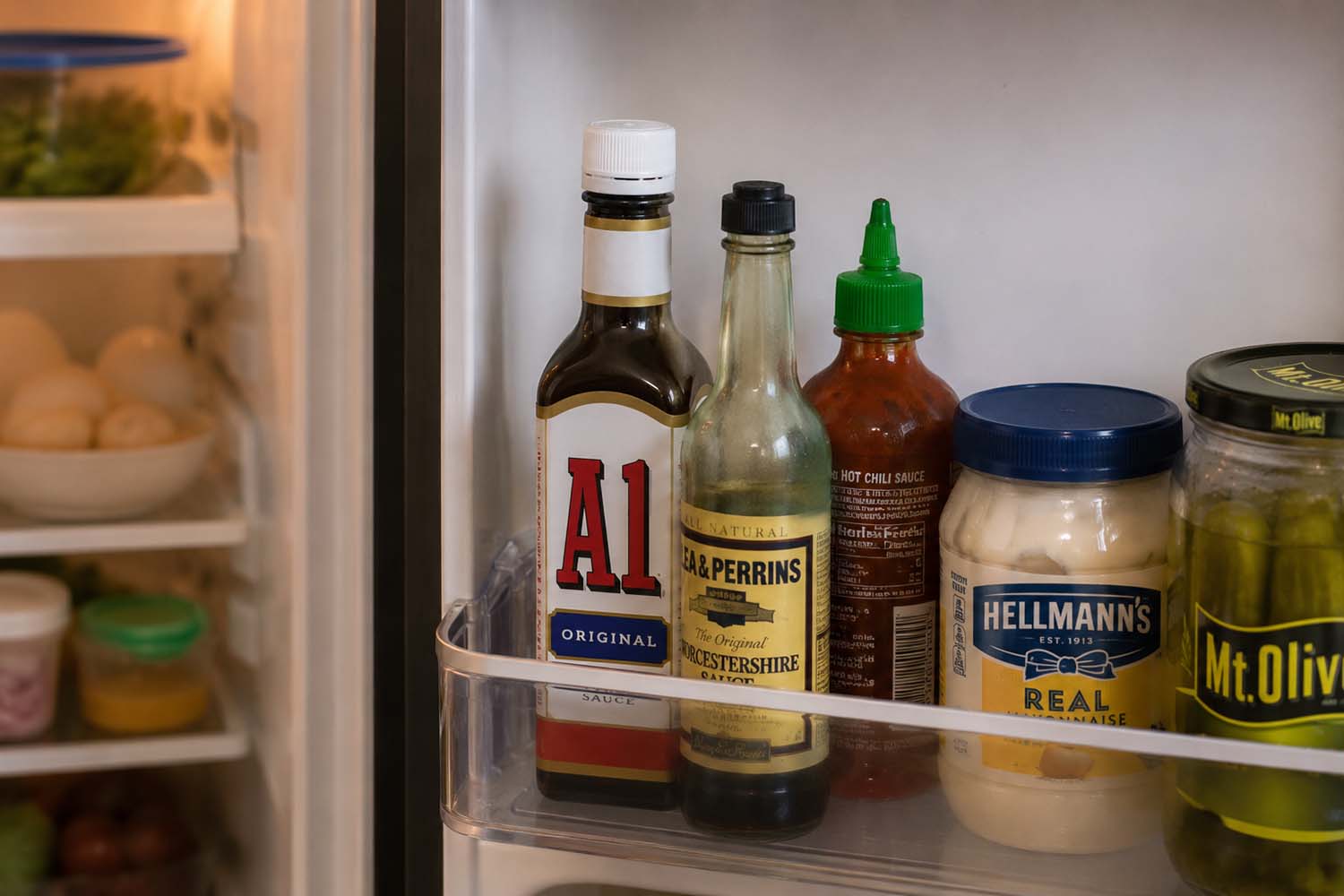
You open a fresh bottle of A1 and notice the label says “refrigerate after opening.” But you have seen it sitting on restaurant tables for hours. So which is it? Does A1 sauce actually need to go in the fridge?
Does A1 sauce need to be refrigerated?
The short answer: A1 sauce does not require refrigeration for food safety after opening. The high vinegar, salt, and potassium sorbate content make it shelf-stable at room temperature. The Kraft Heinz label recommends refrigerating after opening for best quality, meaning refrigeration preserves flavor longer, not that it prevents the sauce from becoming dangerous. Refrigerated A1 stays at peak quality for up to 2 years; pantry-stored A1 is best within 6 months to 1 year.
For a complete reference on storing over 100 foods, see our Food Storage Guide.
- A1 sauce does not need refrigeration for safety. The vinegar, salt, and potassium sorbate preservative keep it shelf-stable after opening.
- The Kraft Heinz label says “refrigerate after opening for best quality,” which is a quality recommendation, not a safety requirement.
- Refrigerated A1 stays at best quality for up to 2 years after opening. Pantry-stored A1 is best within 6 months to 1 year.
- If you use A1 within a month or two, pantry storage is perfectly fine. If the bottle may sit for months, refrigerate it.
Does A1 Sauce Require Refrigeration After Opening?
A1 sauce does not require refrigeration after opening for food safety. Its formulation places it firmly in the shelf-stable condiment category alongside ketchup, Worcestershire sauce, and vinegar-based hot sauces.
🔬 Why A1 Is Shelf-Stable After Opening
The confirmed A1 ingredient list includes tomato puree, raisin paste, spirit vinegar, corn syrup, salt, crushed orange puree, dried garlic and onions, spice, celery seed, caramel color, potassium sorbate, and xanthan gum. Three factors work together to inhibit bacterial growth: the acidity from vinegar lowers the pH to a level where most pathogens cannot survive, the high salt and sugar content draws moisture away from any potential bacterial cells through osmosis, and potassium sorbate actively inhibits mold and yeast growth. The FDA and USDA FoodKeeper treat tomato and vinegar-based condiments in this category the same as ketchup: shelf-stable after opening, though refrigeration extends quality.
What the A1 Label Actually Means
The Kraft Heinz label recommendation to “refrigerate after opening for best quality” is a quality guidance statement, not a food safety warning.
There is a meaningful distinction between these two types of label instructions. Safety-required refrigeration, the kind you see on mayonnaise, ranch dressing, and fresh dairy, means leaving the product unrefrigerated creates a genuine bacterial risk. Quality-recommended refrigeration, which applies to A1, ketchup, mustard, and Worcestershire sauce, means cold storage preserves the flavor complexity and color of the product longer, but the product is not unsafe at room temperature.
A1 falls in the same category as these condiments when it comes to refrigeration after opening:
| Condiment | Refrigerate for Safety? | Refrigerate for Quality? |
|---|---|---|
| A1 steak sauce | No | Yes, extends quality to 2 years |
| Ketchup | No | Yes, extends quality |
| Worcestershire sauce | No | Yes, extends quality |
| Vinegar-based hot sauce | No | Optional |
| Mayonnaise | Yes | Yes |
| Ranch dressing | Yes | Yes |
| Tartar sauce | Yes | Yes |
For the full comparison of steak sauces and the refrigeration question, see our guide on whether steak sauce needs refrigeration.
How Long Does A1 Last Refrigerated vs. Unrefrigerated?
The refrigeration decision is really a question of how quickly you use the sauce and how much you care about preserving its full flavor profile.
See also

| Storage Method | Best Quality Window | Safety Concern? |
|---|---|---|
| Unopened pantry | 2 to 3 years | None |
| Opened, refrigerated | Up to 2 years | None |
| Opened, cool pantry | 6 months to 1 year | None |
| Opened, near heat source | Quality declines rapidly | None |
If you use A1 frequently and go through a bottle within a few weeks or months, pantry storage is perfectly fine. However, if a bottle could sit untouched for six months or longer, refrigerate it. The difference between pantry and fridge storage is not safety. It is whether the sauce still tastes like A1 when you reach for it again. If you are looking for ways to use A1 more regularly, our authentic Mexican steak tacos use it as a marinade base and are a great starting point.
How to Store A1 Sauce After Opening
Whether you store it in the pantry or the fridge, a few habits make a significant difference in how long A1 stays at its best.
- Wipe the rim after every use. Sauce residue on the rim and cap is exposed to air and can develop mold even when the sauce inside is perfectly fine. A quick wipe keeps the seal clean.
- Replace the cap firmly. Air exposure is the primary driver of quality decline in A1. A loose cap accelerates oxidation and flavor loss.
- Keep away from the stove. Heat is the enemy of shelf-stable condiments. Even a pantry-stored bottle should not sit next to or above any heat source.
- Store away from direct light. Light degrades the organic flavor compounds in A1 over time, even through the glass bottle.
- Label the date opened. An opened bottle can easily disappear to the back of a fridge shelf for months without notice.
Visible mold around the cap or rim, fizzing when opened, or a rancid smell that is clearly wrong. These are rare given the high-acid formulation, but they mean the bottle should be discarded. See our full guide on does A1 sauce go bad for complete spoilage signs.
Frequently Asked Questions
Is it okay to leave A1 sauce out overnight?
Yes. Leaving an opened bottle of A1 out overnight is not a food safety concern. The high acid and salt content inhibit bacterial growth at room temperature. The main consequence is marginal quality decline from extended air exposure. Smell it before using the next day. If it smells normal, it is fine.
Why does the A1 label say to refrigerate if it is not required?
Manufacturers include refrigeration guidance to maximize the customer experience with their product. Refrigeration preserves the full flavor complexity of A1 for up to 2 years after opening versus 6 months to 1 year in the pantry. It is sound advice, but it is about quality, not safety. Many people store A1 in the pantry their entire lives without issue.
Can A1 sauce be frozen?
Freezing A1 is not recommended and generally not necessary. The tomato and fruit pectin base can become gelled or watery on thawing, affecting texture. Given that opened A1 already lasts up to 2 years refrigerated, freezing offers no practical benefit for commercial A1 sauce.
Not in any meaningful food safety sense, given the high-acid formulation. However, flavor and color will decline more quickly at room temperature than in the fridge. See our companion post on whether A1 sauce goes bad for the full spoilage guide.
My A1 sauce thickened in the fridge. Is that normal?
Yes. Cold temperatures cause the xanthan gum and tomato solids in A1 to contract slightly, which can make the sauce appear thicker when chilled. This is not a spoilage sign. Let the bottle sit at room temperature for 10 to 15 minutes before using, or run it briefly under warm water. The texture will return to normal.
Does A1 Thick and Hearty need refrigeration?
The same rules apply. A1 Thick and Hearty uses a similar vinegar and tomato base, so refrigeration is recommended for quality but not required for safety. It will last approximately the same amount of time as A1 Original under the same storage conditions. The thicker texture may be slightly more pronounced after refrigeration due to the different formulation.
Why do restaurants leave A1 sauce out on the table all day?
Because it is safe to do so. High-volume restaurants rotate their condiment bottles frequently, and A1 is stable at room temperature. The FDA does not require vinegar and tomato-based condiments like A1 to be held at temperature-controlled conditions. This is the same reason ketchup, mustard, and hot sauce sit on tables at room temperature without issue.
Further Reading
Better Living may earn commissions through affiliate links and may occasionally feature sponsored or partner content. If you make a purchase through our links, we may receive a small commission at no cost to you.