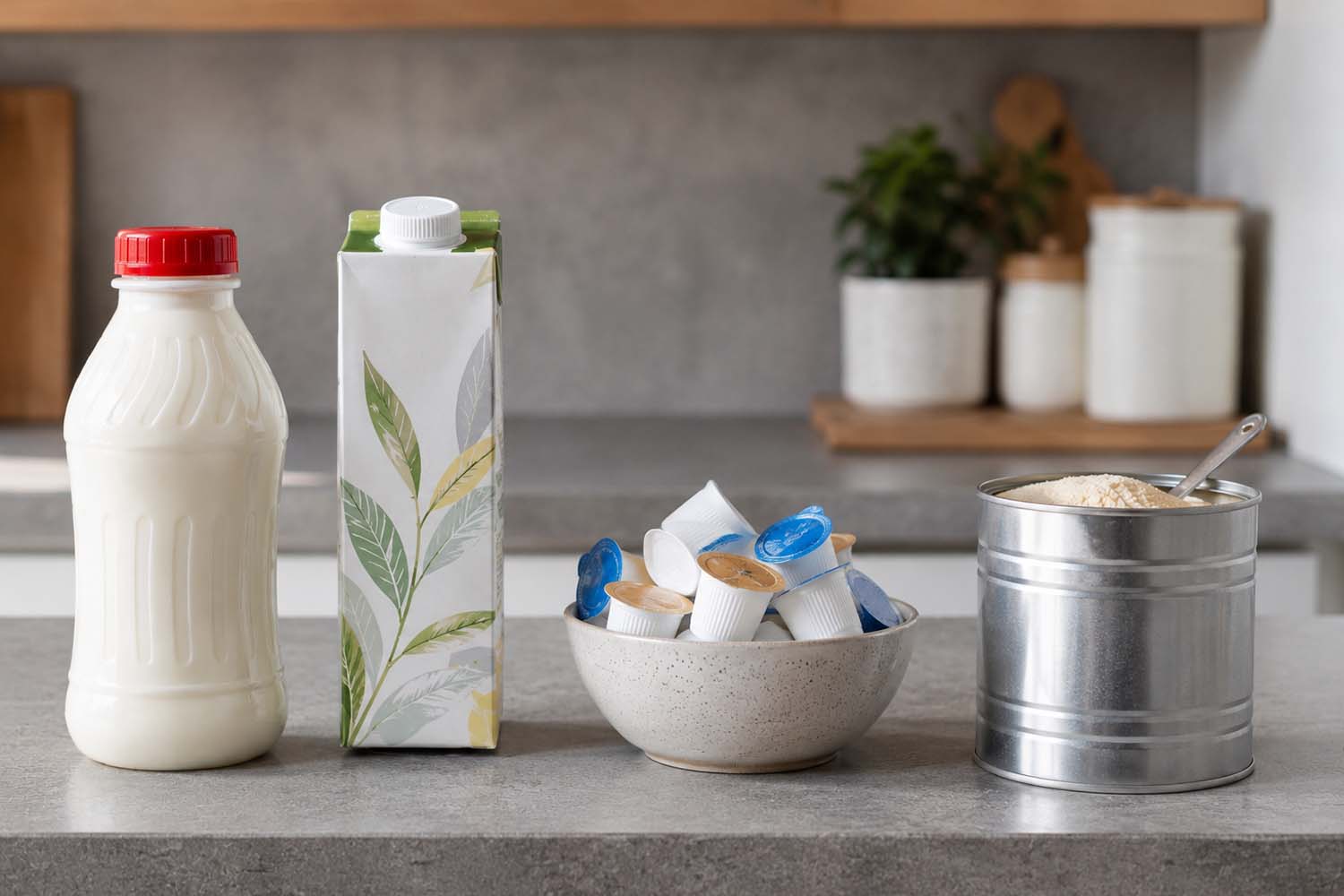
You have a bottle of flavored liquid creamer in the fridge from two weeks ago and you are not sure if it is still good. There is also a container of powdered creamer in the pantry that you opened months ago, and a box of those little individual sealed cups that have been sitting in the cabinet since last year. Which of these is still safe to use?
Does coffee creamer go bad?
The short answer: Yes, but the timeline varies significantly depending on the type. Refrigerated liquid dairy creamer lasts 5 to 14 days after opening depending on the brand. International Delight recommends 5 to 7 days; Coffee-Mate up to 2 weeks. Always check the label. Shelf-stable liquid non-dairy creamer lasts 7 to 14 days after opening once refrigerated. Mini sealed cups last up to 1 year at room temperature unopened. Powdered creamer lasts 18 to 24 months unopened and 3 to 6 months after opening. All opened liquid creamers should be discarded after 2 hours at room temperature per USDA guidelines.
For related coffee storage guidance, see Does Coffee Go Bad? and Does Coffee Need to Be Refrigerated?
Key Takeaways
- Refrigerated liquid dairy creamer: 5 to 14 days after opening depending on brand; check the label
- Shelf-stable liquid non-dairy creamer: 7 to 14 days after opening (refrigerate immediately)
- Mini sealed cups and pods: up to 1 year at room temperature; 1 week past best-by date
- Powdered creamer: 18 to 24 months unopened; 3 to 6 months after opening
- All opened liquid creamers: 2-hour room temperature limit per USDA
- Do not pour unused creamer back into the original container
- Sour smell, curdling, clumping, or skin on the surface all mean discard
Not All Coffee Creamer Is the Same
Coffee creamer is not one product with one set of storage rules. There are four distinct types, and each behaves differently in storage. Applying the rules for one to another is the most common mistake people make with creamer shelf life.
Refrigerated liquid dairy creamer is sold in the refrigerated section and must stay there from the moment you buy it. It is made with dairy ingredients and has a shorter shelf life than shelf-stable options. Brands like Coffee-Mate in the refrigerated section, International Delight, and similar products fall into this category.
Shelf-stable liquid non-dairy creamer sits on an unrefrigerated grocery shelf until you open it. It goes through ultra-high temperature (UHT) processing, which kills bacteria and allows room-temperature storage. Once opened, however, it must be refrigerated immediately. This type includes most non-dairy flavored creamers in tetra-pack cartons.
Mini sealed cups and pods are the small individual-serving creamers found at coffee shops and in office kitchens. They are shelf-stable and require no refrigeration until opened. Once you tear one open, use it immediately.
Powdered creamer has the longest shelf life of any creamer type because the removal of moisture eliminates the environment bacteria need to grow. It stores at room temperature and does not require refrigeration. For a closer look at flavored powdered options, see our Splenda coffee creamers review. If you prefer dairy alternatives instead, see our guide to the best non-dairy milk for coffee or how long half-and-half lasts.
How Long Does Coffee Creamer Last?
| Type | Unopened | After Opening | Room Temp Limit |
|---|---|---|---|
| Refrigerated liquid dairy | Until best-by date | 5 to 14 days (check label) | 2 hours max |
| Shelf-stable liquid non-dairy | Several months to 1 year | 7 to 14 days (refrigerated) | 2 hours max once opened |
| Mini sealed cups and pods | Up to 1 year; 1 week past best-by | Use immediately | Use immediately |
| Powdered creamer | 18 to 24 months | 3 to 6 months | Indefinite if kept dry |
All figures per USDA. Always check the manufacturer’s label for the specific product you have, as formulations vary.
How to Tell If Coffee Creamer Has Gone Bad
The most reliable sign that coffee creamer has gone bad is a sour or off smell. For powdered creamer, clumping and a rancid odor are the key indicators.
Your senses are the most reliable tool here. Fresh creamer smells neutral to mildly sweet. Fresh liquid creamer pours smoothly and evenly. Powdered creamer dissolves cleanly with no clumps.
Signs Coffee Creamer Has Gone Bad
- Sour or off smell: Fresh creamer smells neutral or slightly sweet. A sour, vinegary, or otherwise unpleasant odor means discard immediately. This applies to both dairy and non-dairy liquid creamers.
- Curdling or chunky consistency: Pour a small amount into a clear glass before adding to coffee. Any separation into chunks, clumps, or curds indicates spoilage. Do not add curdled creamer to hot coffee hoping it will dissolve. It will not, and the spoilage remains.
- Skin on the surface: A film or skin forming on the surface of liquid creamer is a sign of spoilage. In dairy creamers this indicates bacterial activity; in non-dairy creamers it can indicate oxidized oils. Either way, discard the container.
- Color change: Any discoloration beyond the normal off-white to cream color of fresh creamer indicates deterioration.
- Clumping in powdered creamer: Powder that has clumped into solid masses has absorbed moisture. The flavor has deteriorated and mold may follow. Discard.
- Rancid or paint-like smell in powdered or oil-based creamer: This indicates the fats in the creamer have oxidized and gone rancid. The creamer is not safe to use.
One Rule That Applies to All Liquid Creamers
Never pour unused liquid creamer back into the original container. Once creamer has been poured out and potentially exposed to a cup, spoon, or the air above a coffee mug, it has picked up bacteria and contaminants. Pouring it back introduces those contaminants into the rest of the bottle and accelerates spoilage for the entire container. Pour only what you need and return the container to the refrigerator immediately after use.
The 2-Hour Rule for Liquid Creamer
Opened liquid creamer left at room temperature follows the USDA two-hour rule that applies to all perishable foods. After two hours above 40 degrees Fahrenheit, bacteria multiply rapidly in the dairy or oil-based components of the creamer. If your creamer has been sitting out for longer than two hours, discard it. In a warm kitchen above 90 degrees Fahrenheit, that window drops to one hour.
See also

This also applies to coffee that already has creamer in it. A cup of coffee with liquid dairy creamer added should be consumed within two hours at room temperature. Coffee with powdered creamer is more forgiving and remains safe for three to four hours at room temperature, because the powder’s lower moisture content slows bacterial activity. If you are a slow sipper, powdered creamer is the safer choice. For drinks like an eggnog latte or Irish coffee that combine dairy and other ingredients, apply the same two-hour rule.
Can You Freeze Coffee Creamer?
Yes, with caveats. Non-dairy liquid creamers freeze well and are the better candidate for freezing. Pour into an ice cube tray, freeze until solid, then transfer cubes to a freezer bag. Each cube provides a single-serving portion that thaws quickly. Shake or stir after thawing to reintegrate any separation.
Dairy-based liquid creamers can be frozen but may develop a grainy or separated texture after thawing. The flavor remains acceptable but the consistency changes. Shake thoroughly after thawing. Powdered creamer does not need to be frozen and actually freezes poorly due to the risk of moisture absorption during the freeze-thaw cycle. Store powder in the pantry as directed.
Further Reading
Does Coffee Creamer Go Bad FAQ
How long does liquid coffee creamer last after opening?
It depends on the brand. International Delight recommends consuming within 5 to 7 days of opening. Coffee-Mate liquid lasts up to 2 to 3 weeks according to the manufacturer. As a general working range, plan on 7 to 14 days for most refrigerated liquid creamers and always check your specific label. Shelf-stable non-dairy liquid creamer lasts 7 to 14 days after opening once moved to the refrigerator. The aroma test is reliable regardless of brand: if it smells sour or off at any point within those windows, discard it without tasting. If you prefer a simpler alternative, half-and-half follows similar storage rules with fewer additives.
Can you use coffee creamer past its expiration date?
It depends on the type. Powdered creamer is often still usable for months past the best-by date if it has been stored in a cool dry place, shows no clumping or off smell, and dissolves normally. Mini sealed cups are often safe up to a week past their best-by date if the seal is intact. Liquid dairy creamer should not be used past its expiration date, and even within date, always perform the smell and visual test first. The expiration date is a quality indicator, not always a safety cutoff, but liquid dairy creamer is not worth the risk past its date.
What happens if you drink spoiled coffee creamer?
Consuming spoiled liquid creamer can cause foodborne illness symptoms including nausea, stomach cramps, vomiting, and diarrhea. Dairy-based spoilage involves bacterial growth that accelerates rapidly once the creamer leaves the safe temperature zone. Non-dairy creamer spoilage can involve rancid fats that cause gastrointestinal distress. The risk is higher with liquid creamers that have been left out or stored past their window. Powdered creamer that has gone rancid typically tastes unpleasant before it causes harm, which serves as a natural deterrent.
How long do those little individual creamer cups last?
Mini sealed cups are shelf-stable and typically last up to one year at room temperature in a cool dry place. They are often safe to use up to one week past the best-by date if the seal is completely intact and the cup shows no damage. Once you open a mini cup, use the contents immediately. There is no way to reseal a torn mini cup, and the exposed creamer should not be saved for later.
Does non-dairy creamer go bad faster than dairy creamer?
Not necessarily. Unopened shelf-stable non-dairy liquid creamer actually lasts longer than refrigerated dairy creamer because of UHT processing and preservatives. Once opened, both types last a similar window of 7 to 14 days refrigerated. The main difference is that dairy creamer carries a higher food safety risk when left out because of its dairy content, while non-dairy creamer may develop rancid off-flavors from its oil base rather than bacterial spoilage. Both should be treated with the same care once opened.
Better Living may earn commissions through affiliate links and may occasionally feature sponsored or partner content. If you make a purchase through our links, we may receive a small commission at no cost to you.