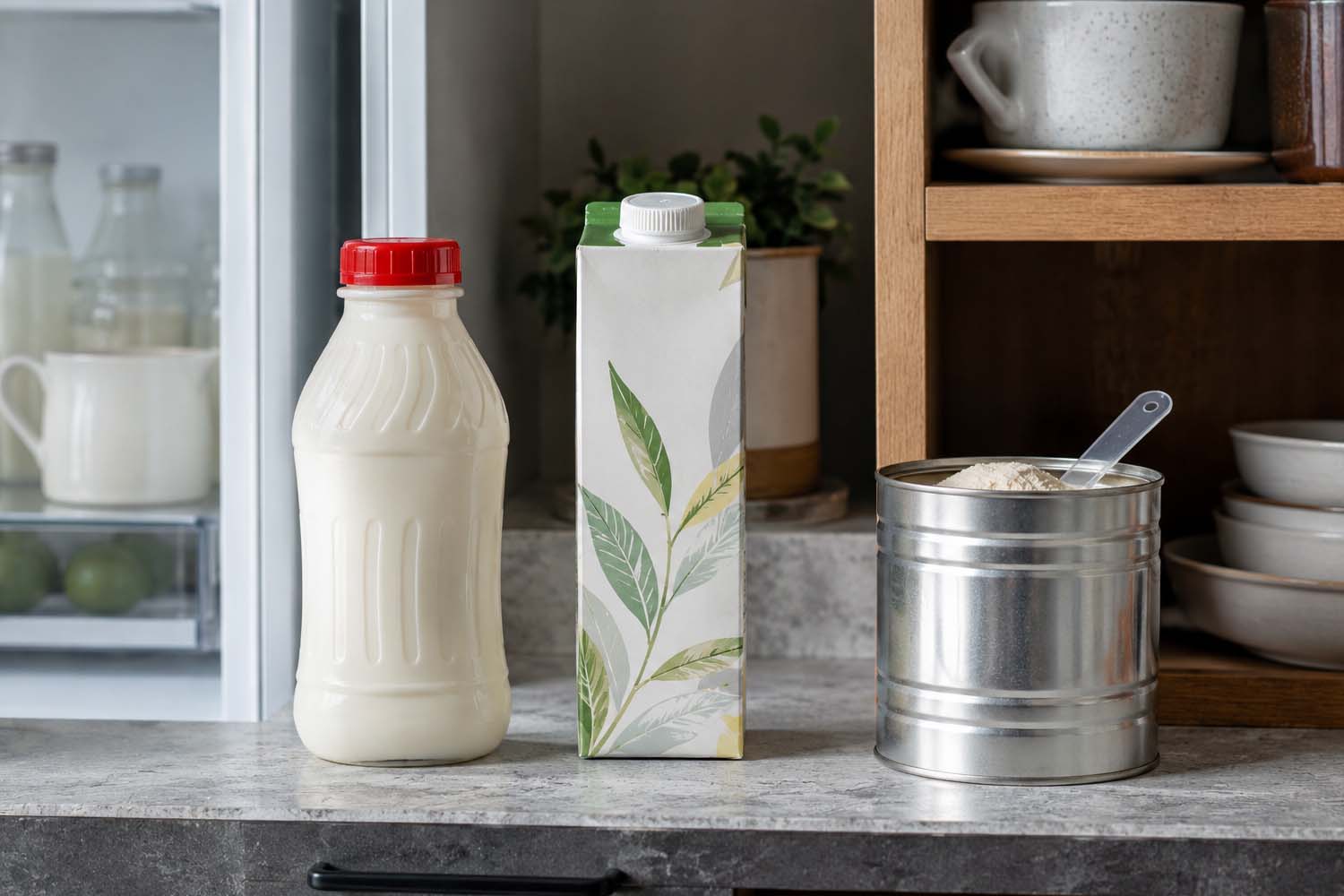
You bought two different coffee creamers this week: a bottle from the refrigerated dairy section and a carton from the shelf near the coffee. Now you are wondering whether both need to go in the fridge or whether the rules are different for each. They are. The type of creamer you have determines where it lives, and getting this wrong in either direction wastes good creamer or creates a food safety risk.
Does coffee creamer need to be refrigerated?
The short answer: It depends entirely on the type. Refrigerated dairy liquid creamer must stay in the refrigerator at all times, even before opening. Shelf-stable non-dairy liquid creamer lives in the pantry until opened, then must move to the refrigerator immediately. Powdered creamer never needs refrigeration and belongs in a cool dry pantry. Mini sealed cups need no refrigeration until the seal is broken.
For shelf life figures and spoilage signs for each type, see our companion post Does Coffee Creamer Go Bad?
Key Takeaways
- Refrigerated dairy liquid creamer: fridge always, even before opening
- Shelf-stable non-dairy liquid creamer: pantry until opened, fridge immediately after
- Mini sealed cups and pods: pantry until opened, use immediately once open
- Powdered creamer: cool dry pantry always, never needs refrigeration
- All opened liquid creamers: 2-hour room temperature limit per USDA
- Never store liquid creamer in the refrigerator door: temperature fluctuates too much
Refrigerated Dairy Creamer: Always in the Fridge
If you picked up your creamer from the refrigerated section of the grocery store, it needs to stay refrigerated from that moment on. This type of creamer contains dairy ingredients that require consistent cold temperatures to stay safe. Leaving it at room temperature, even briefly on the drive home, is not ideal. Once home, it goes straight to the refrigerator and stays there until you open it. If you prefer a simpler dairy option with fewer additives, half-and-half follows the same refrigeration rules and lasts a similar window after opening.
After opening, refrigerated dairy creamer shelf life varies by brand. International Delight recommends using within 5 to 7 days. Coffee-Mate liquid lasts up to 2 to 3 weeks. As a practical rule, plan on 7 to 14 days and always check your specific label. Seal the container tightly after each use and return it to the fridge immediately. Do not leave it on the counter while you make your coffee. The USDA two-hour rule applies: liquid dairy creamer left at room temperature for more than two hours should be discarded.
One important note from The Takeout: store liquid creamer on a refrigerator shelf, not in the door. The door experiences the most temperature fluctuation from opening and closing, which accelerates spoilage. A shelf toward the back of the refrigerator, where temperatures are most stable, is the better location for any dairy-based creamer.
Shelf-Stable Non-Dairy Creamer: Pantry Until Opened, Fridge After
Shelf-stable non-dairy liquid creamers go through ultra-high temperature (UHT) processing, which kills bacteria and allows them to sit unrefrigerated on a store shelf for months. Before you open the seal, a cool dry pantry is the right storage spot. In fact, refrigerating an unopened shelf-stable carton is unnecessary and wastes refrigerator space.
The moment you break the seal, everything changes. Opening the carton ends the sterile environment that UHT processing created. Bacteria from the air, your hands, or the pouring surface can now enter the product. As a result, the carton must go into the refrigerator immediately after first opening and stay there. Use within 7 to 14 days after opening. Most cartons print a “refrigerate after opening” instruction on the label, which is exactly right.
This category includes most non-dairy flavored creamers in tetra-pack cartons that sit on unrefrigerated grocery shelves. If you are looking for specific options, see our review of Splenda coffee creamers or our guide to the best non-dairy milk for coffee for alternatives to traditional creamer.
Powdered Creamer: Never Needs Refrigeration
Powdered creamer does not need refrigeration at any point. Manufacturers remove moisture during production, and without moisture, bacteria cannot grow. This makes powdered creamer one of the most shelf-stable coffee additions available. Store it in a cool dry pantry in a sealed container and it will last 18 to 24 months unopened and 3 to 6 months after opening.
The one risk with powdered creamer is moisture exposure, not temperature. Keep the lid sealed tightly between uses. Never store it near the stove, sink, or dishwasher where steam and humidity can enter the container. A dry spoon is essential: a wet spoon introduced into a powdered creamer container can cause clumping and accelerate deterioration. Refrigerating powder actually increases the risk of moisture exposure through condensation when you remove it from the cold and open it in a warmer room.
Mini Sealed Cups: No Refrigeration Needed
Those small individual sealed cups found at coffee shops, in offices, and sold in bulk packs are shelf-stable until opened. Store them in a cool dry pantry or cupboard, away from direct sunlight and heat. They last up to one year and are often usable up to one week past their best-by date if the seal is completely intact.
Once you peel or tear open the seal, use the cup immediately. There is no way to reseal a mini cup and the exposed creamer should not be saved. This makes mini cups ideal for travel, office use, and situations where refrigeration is not available. For specialty coffee preparations like Scottish coffee or Irish coffee where you want a precise small amount of creamer, mini cups are a convenient option.
Quick Storage Reference
See also

- Refrigerated dairy liquid creamer: Fridge always. Even before opening. On a shelf, not in the door. 5 to 14 days after opening depending on brand; check the label.
- Shelf-stable non-dairy liquid creamer: Cool dry pantry until opened. Refrigerate immediately after opening. 7 to 14 days after opening.
- Mini sealed cups: Cool dry pantry or cupboard. Up to 1 year. Use immediately once opened.
- Powdered creamer: Cool dry pantry always. Sealed tightly. 18 to 24 months unopened. 3 to 6 months after opening. Never refrigerate.
Why UHT Processing Changes the Rules
Ultra-high temperature (UHT) processing heats liquid to approximately 280 degrees Fahrenheit for 2 to 4 seconds, which kills virtually all bacteria and creates a commercially sterile product. The liquid is then sealed in sterile packaging. This process is why shelf-stable non-dairy creamers, as well as shelf-stable milk and some coffee beverages, can sit unrefrigerated for months without spoiling. The key word is “until opened.” Once you break the seal, the sterile environment ends immediately. From that point, the product is no more shelf-stable than any other opened liquid dairy alternative and must be refrigerated. The same UHT process is applied to shelf-stable tofu, aseptic milk, and certain coffee beverages, all of which follow the same open-and-refrigerate rule.
Further Reading
Does Coffee Creamer Need to Be Refrigerated FAQ
Does Coffee-Mate need to be refrigerated?
It depends on which Coffee-Mate product you have. Coffee-Mate liquid creamer sold in the refrigerated dairy section must be refrigerated at all times. Coffee-Mate Natural Bliss, also in the refrigerated section, is the same. Coffee-Mate powder in a canister does not need refrigeration and belongs in the pantry. Coffee-Mate liquid creamer in a shelf-stable bottle or carton from the unrefrigerated aisle stays in the pantry until opened, then must be refrigerated. Check where you found it in the store: that location tells you whether it is refrigerated or shelf-stable.
Can you leave coffee creamer out overnight?
No. Opened liquid creamer left out overnight has been at room temperature for far more than the USDA’s two-hour limit for perishable foods. Discard it. This applies to both dairy and non-dairy liquid creamers once opened. Powdered creamer is the one exception: it can sit out indefinitely as long as it stays dry and sealed. If you want to leave cream out for an extended period, powdered creamer is the right choice for that use case.
Why does my creamer say “refrigerate after opening” if it was on the shelf?
Because it is a shelf-stable product that has been UHT processed and sealed in sterile packaging. Before the seal is broken, it does not need refrigeration because the sterile environment inside the packaging prevents bacterial growth. Once you open it, the sterile environment ends immediately and bacteria from the surrounding air, surfaces, and your hands can enter. From that point on, refrigeration is required to slow bacterial growth. The “refrigerate after opening” label is accurate and important to follow.
Can you store creamer in the refrigerator door?
It is better not to. The refrigerator door experiences the most temperature fluctuation of any location in the fridge because it is exposed to room temperature every time you open the door. For dairy creamer in particular, these repeated temperature changes accelerate spoilage. Store liquid creamer on a middle or back shelf where the temperature stays most consistent, ideally between 35 and 38 degrees Fahrenheit.
Better Living may earn commissions through affiliate links and may occasionally feature sponsored or partner content. If you make a purchase through our links, we may receive a small commission at no cost to you.