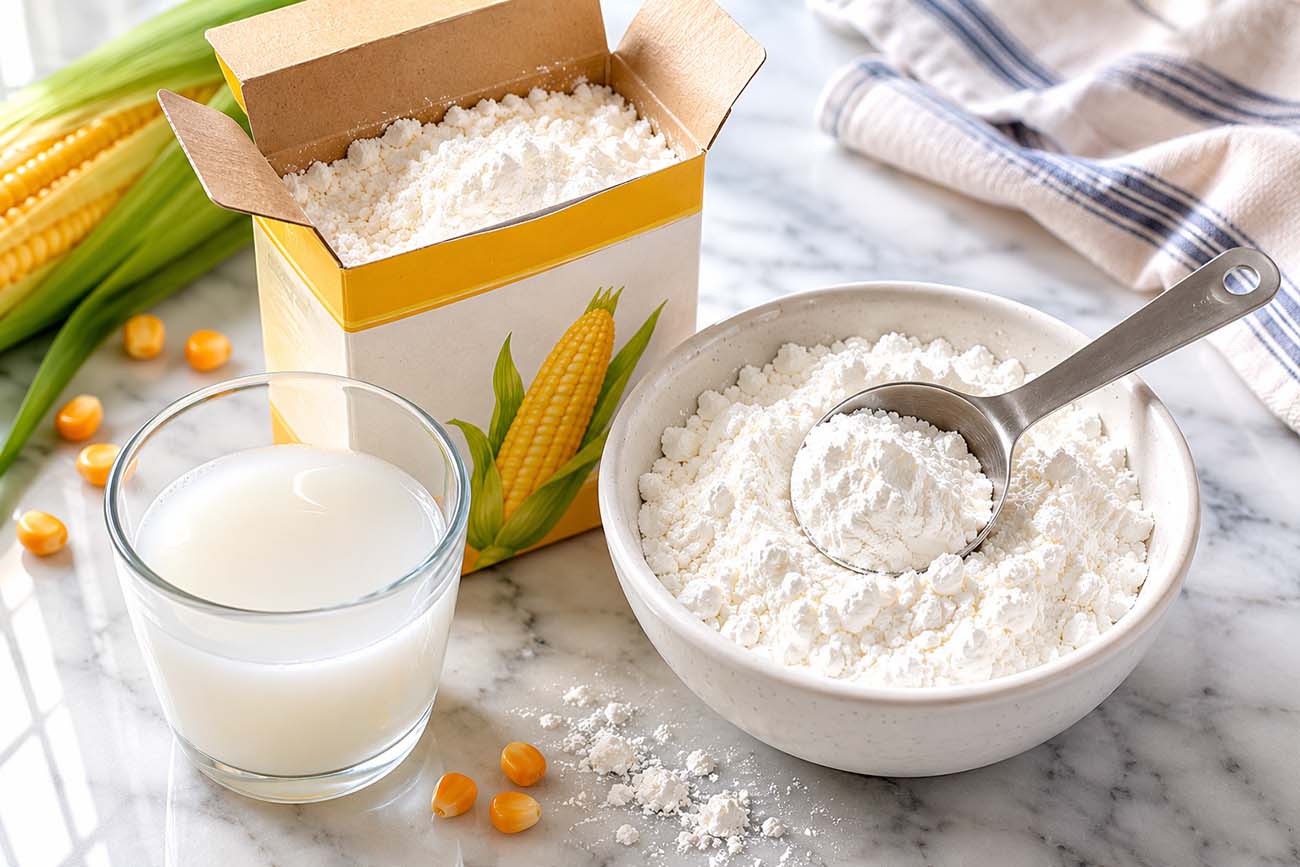
You find a box of cornstarch in the pantry with a best-by date from three years ago. Or you have an open container that has been sitting in a cabinet for longer than you can remember. Before you throw it out, there is something important to know about this particular pantry staple.
Does cornstarch go bad?
The short answer: Cornstarch does not go bad under normal storage conditions and has an indefinite shelf life when kept dry. The USDA classifies it as a shelf-stable dry good. Unlike baking powder or cream of tartar, cornstarch does not lose its thickening power over time. A box stored for five years in a cool, dry pantry performs identically to a fresh box in sauces, gravies, and pie fillings. The only genuine threats are moisture, which causes clumping and mold risk, and insects. If it is dry, clump-free, and smells neutral, it is still good.
For a full overview of how baking staples compare on shelf life, visit our Complete Food Storage Guide.
📋 Cornstarch: At a Glance
- Shelf life: indefinite when stored dry. Best-by dates on cornstarch packaging are quality estimates, not safety or potency cutoffs.
- Does not lose thickening power over time. This is the critical difference from baking powder and cream of tartar. Age alone does not affect cornstarch’s ability to thicken.
- Moisture is the only real enemy. Wet cornstarch clumps, can develop mold, and loses its thickening effectiveness. Keep it completely dry.
- Insects are the second risk. Weevils and pantry moths can infest dry cornstarch. An airtight hard-sided container prevents this.
- Do not refrigerate or freeze. Cold storage introduces condensation and can damage cornstarch’s thickening properties when thawed.
- Gluten-free. Cornstarch is derived entirely from the starch of corn kernels and contains no gluten.
Key Takeaways
- Cornstarch is uniquely stable among baking starches. Unlike baking powder, cream of tartar, and yeast, it does not lose potency with age. Time alone will not weaken it.
- The best-by date on cornstarch is not meaningful in the same way as other baking ingredients. Argo and Clabber Girl print best-by dates voluntarily as a quality guideline, not because cornstarch actually degrades on a predictable timeline.
- Clumped cornstarch is not necessarily spoiled. Small soft clumps from humidity can be broken up and the cornstarch used normally. Dense, wet clumps with any off smell or discoloration should be discarded.
- The check is simple: look for moisture damage, mold, insects, or off odor. If none of those are present, use it regardless of the date.
- Cornstarch is gluten-free, making it the preferred thickener for gluten-free cooking over flour-based alternatives.
How Long Does Cornstarch Last?
Cornstarch’s shelf life stands apart from nearly every other baking ingredient because it is composed almost entirely of pure starch with virtually no protein, fat, or available moisture. This composition means there is nothing for bacteria or mold to metabolize under normal storage conditions, and nothing to oxidize or lose potency the way fats and leavening agents do.
| Storage Status | Shelf Life | Thickening Power |
|---|---|---|
| Sealed, cool dry pantry | Indefinite | Unchanged with age |
| Opened, airtight container, dry pantry | Indefinite | Unchanged with age |
| Exposed to humidity or steam | Compromised; clumping and mold risk | Reduced if clumped; discard if moldy |
| Insect contamination | Discard | Not applicable |
Shelf life guidance per USDA classification of cornstarch as a shelf-stable dry good. The USDA reports cornstarch moisture content at approximately 8.32%, far below the threshold required for microbial growth. Argo and Clabber Girl print best-by dates on packaging as a quality guideline, not a potency or safety cutoff. Thickening power is not affected by age when cornstarch is stored dry.
Why Cornstarch Is Different from Other Baking Ingredients
The Key Distinction: No Potency Loss Over Time
This is the most important thing to understand about cornstarch compared to the other ingredients in your baking cabinet.
Baking powder loses its leavening power because it contains an acid and a base that gradually react with each other and with ambient moisture over time. Cream of tartar loses acidity through similar moisture-driven changes. Yeast cells die. Flour’s oils go rancid. All of these ingredients have active chemistry that changes with time or conditions.
Cornstarch is different. It is composed primarily of two starch molecules: amylose and amylopectin. These long-chain carbohydrate molecules are chemically inert at room temperature and do not react with air, time, or each other in storage. When you heat cornstarch in liquid, the starch granules absorb water, swell, and break down, releasing their starch molecules into the liquid to create the thick, glossy gel we use in sauces and fillings. This gelatinization process depends on heat and water, not on any reactive chemistry that could be depleted or weakened over time in storage.
The USDA classifies cornstarch as a shelf-stable dry good with approximately 8.32% moisture content, well below the water activity level that supports microbial growth. Argo and Clabber Girl, the leading consumer brands, do not indicate any potency loss over time in their storage guidance. Multiple food science sources confirm cornstarch retains its thickening effectiveness indefinitely when stored dry. This is why the indefinite shelf life is not marketing language but an accurate description of the ingredient’s chemistry.
What Actually Goes Wrong with Cornstarch
The Real Spoilage Risks
Moisture (the primary risk): Cornstarch is highly hygroscopic and absorbs moisture from the air readily. When enough moisture enters the container, the starch granules partially hydrate and clump together. Small soft clumps can usually be broken up with a fork or sifted out and the cornstarch used normally. Dense hard clumps that have been wet and dried indicate more serious moisture exposure. Any clumps with discoloration or off-smell should be discarded along with the rest of the container.
Mold (from moisture exposure): Dry cornstarch cannot support mold growth. However, if significant moisture has entered the container, mold can develop in the wet areas. Any visible fuzzy growth means discard the entire container immediately. Do not attempt to scoop around visible mold in cornstarch.
Insects: Pantry weevils, flour beetles, and pantry moths are attracted to dry starches. Cornstarch is no exception. If you notice small brown insects moving in the powder, webbing, larvae, or dark specks of frass (insect droppings), discard the entire container and clean it thoroughly before refilling. Insects can penetrate cardboard and thin plastic packaging but cannot get into hard-sided airtight containers.
Off odor: Pure cornstarch has a neutral, faintly sweet or earthy odor. Any musty, sour, or otherwise unpleasant smell indicates moisture damage or contamination. Discard if the smell is clearly wrong.
What is not a problem: Age, time, and past best-by dates alone are not reasons to discard cornstarch. A box that is five years old and stored properly in a dry, sealed container is as effective as a fresh box.
How to Test Cornstarch for Quality
Quick Quality Checks
Unlike baking powder or cream of tartar, cornstarch does not need a special potency test because its thickening power does not degrade with age. The checks are simpler:
Visual check: Cornstarch should be a fine, white, silky powder. Sift a small amount onto a dark surface and look for discoloration, dark specks, insect fragments, or moisture damage. White and uniform means proceed.
Smell check: Rub a small pinch between dry fingers and smell it. Neutral, faintly sweet or earthy is fine. Musty, sour, or off means discard.
Clump check: Small soft clumps are moisture absorption and can be broken up. Hard dense clumps or any clumps with discoloration warrant closer inspection. Break them open: if the interior is white and neutral-smelling, it is still usable. If it is discolored, smells off, or shows any fuzzy growth, discard the container.
Quick water test (optional): Mix 1 teaspoon of cornstarch with 1/4 cup of cold water and stir. It should form a smooth, milky-white slurry with no lumps that resist dissolving. If it dissolves cleanly, the cornstarch is intact. This confirms the starch is undamaged but is generally not necessary unless you have specific reason to doubt the quality.
How to Store Cornstarch Properly
Storage Best Practices
Airtight container in a cool, dry pantry. Argo and Clabber Girl both sell cornstarch in containers with twist-on lids that create a reasonably good seal. If your cornstarch came in a box with a loose-fitting lid or a bag, transfer it to a hard-sided airtight container with a proper seal. Glass jars, food-grade plastic containers with locking lids, and ceramic canisters all work well.
Away from steam and moisture sources. Never measure cornstarch directly over a boiling pot. Steam introduced into the container triggers the same partial hydration that causes clumping. Use a completely dry spoon every time you scoop.
Away from the stove, dishwasher, and sink. Any source of steam or heat should be avoided. A cabinet on the opposite side of the kitchen is better than one directly above or beside cooking appliances.
Do not refrigerate. The refrigerator introduces condensation every time the container is moved from cold to room temperature. This is exactly the moisture exposure that causes cornstarch problems. A cool pantry is always preferable to refrigerator storage for cornstarch.
Do not freeze. Freezing cornstarch and then thawing it can damage its thickening properties. Sources including The Provident Prepper specifically warn that cornstarch can lose its thickening ability after freeze-thaw cycles. This is because the freezing process causes ice crystal formation that can physically disrupt the starch granule structure. Keep cornstarch at stable room temperature.
Label with the opening date. Not because it affects potency, but because it helps you track stock rotation and reminds you how long the container has been open, which matters if you are checking for moisture or insect issues.
Cornstarch vs. Flour as a Thickener
Cornstarch and all-purpose flour are often used interchangeably as thickening agents, but they are not the same. Cornstarch is roughly twice as powerful as flour as a thickener: use half as much cornstarch as you would flour for the same thickening effect. Cornstarch also produces a clearer, glossier, more translucent sauce or filling, while flour produces an opaque, more matte result.
Cornstarch is gluten-free; flour is not. For anyone avoiding gluten, cornstarch is the preferred thickening agent. See our companion post Does Flour Go Bad? for flour’s shelf life, which is significantly shorter than cornstarch’s because of flour’s fat and protein content.
One important cooking note: cornstarch-thickened sauces do not hold up to prolonged high heat or acid. Cooking a cornstarch-thickened sauce for too long or adding acidic ingredients like lemon juice or vinegar after thickening can cause the sauce to thin again. Flour-thickened sauces are more stable in both situations.
Recipes That Use Cornstarch
- Clam Corn Chowder: cornstarch gives this chowder its silky, thick body without the heaviness of a roux
- Easy Healthy Coleslaw: some coleslaw dressings use a small amount of cornstarch to help the dressing cling
- Teriyaki Pork Bowls: cornstarch is essential in teriyaki and stir-fry glazes for that glossy, restaurant-style finish
- Does Flour Go Bad?: the other major pantry thickener with a much shorter shelf life than cornstarch
- Does Sugar Go Bad?: powdered sugar contains about 3% cornstarch as an anti-caking agent, which is why it clumps differently than granulated sugar
- Does Baking Powder Go Bad?: baking powder contains cornstarch as a moisture-absorbing buffer between the acid and base components
See also

Frequently Asked Questions
Does cornstarch expire?
No, cornstarch does not expire in any meaningful sense. It has an indefinite shelf life when stored dry and away from insects. The best-by dates printed on Argo, Clabber Girl, and other brands are quality guidelines, not potency or safety cutoffs. Cornstarch stored for years past its printed date performs identically to fresh cornstarch in thickening sauces, gravies, and pie fillings, provided it has remained dry and uncontaminated.
Does cornstarch lose its thickening power over time?
No. This is the critical difference between cornstarch and other baking ingredients like baking powder or cream of tartar. Cornstarch is composed of chemically stable starch molecules that do not react or degrade with age alone. Its thickening power comes from a physical process (starch gelatinization when heated in liquid) rather than a chemical reaction that could be depleted over time. Age does not weaken it. Moisture damage can affect how clumped cornstarch disperses, but dry cornstarch performs the same at any age.
My cornstarch has clumps. Is it still good?
Yes, in most cases. Small soft clumps form when cornstarch absorbs trace moisture from the air. Break them up with a fork or press through a fine mesh sieve. Once the powder is loose, it thickens identically to unclumped cornstarch. Hard dense clumps or clumps with any discoloration or off smell are a sign of more significant moisture exposure: inspect them closely and discard the container if there is any mold, unusual color, or bad odor.
Is cornstarch gluten-free?
Yes. Cornstarch is derived from the starch of corn kernels, a naturally gluten-free grain. It contains no wheat, barley, or rye. It is the preferred thickener for gluten-free cooking because it performs the same thickening function as flour without any gluten. People with celiac disease or gluten sensitivity can use pure cornstarch safely. If cross-contamination is a concern, check that the specific brand is processed in a dedicated gluten-free facility.
Should cornstarch be refrigerated?
No. Refrigerating cornstarch is counterproductive and unnecessary. The refrigerator introduces condensation every time the container is moved between cold and room temperature, which creates exactly the moisture exposure that causes clumping and potential spoilage. A cool, dry, sealed pantry is the correct storage method. Cornstarch should never be frozen either: freeze-thaw cycles can disrupt the starch granule structure and reduce thickening effectiveness.
What is the difference between cornstarch and corn flour?
Cornstarch and corn flour are different products made from different parts of the corn kernel. Cornstarch is refined from the starchy endosperm only, producing a fine, silky white powder used primarily as a thickener. Corn flour is made from ground whole corn kernels, producing a yellow powder with a corn flavor used in baked goods like cornbread, tortillas, and some coatings. They are not interchangeable. In the UK, “corn flour” often refers to what Americans call cornstarch, which adds to the confusion: always check context and packaging when a recipe specifies either one.
Can cornstarch make you sick?
Old or clumped cornstarch that is otherwise undamaged will not make you sick. The only genuine safety concerns are mold (possible if moisture has been introduced) and insect contamination. Moldy cornstarch should always be discarded. Cornstarch with insect contamination should also be discarded and the container cleaned. Dry, uncontaminated cornstarch regardless of age is safe to use and consume in cooked recipes.
How much cornstarch do I use to thicken a sauce?
A general starting point is 1 tablespoon of cornstarch per 1 cup of liquid for a medium-thick sauce. For a thicker result, use up to 2 tablespoons per cup. Always mix cornstarch with an equal amount of cold water first to make a slurry, then whisk the slurry into the hot liquid. Adding dry cornstarch directly to hot liquid causes immediate clumping. The sauce will thicken as it returns to a boil and then clears slightly to a glossy, translucent finish. If the sauce thins again after a few minutes of cooking, the heat was too high or the acid content was too high.
What can I substitute for cornstarch?
The most direct substitute for cornstarch as a thickener is arrowroot powder, which behaves similarly, produces a clear gel, and is also gluten-free. Substitute 1:1. All-purpose flour can substitute at twice the amount: use 2 tablespoons of flour for every 1 tablespoon of cornstarch, but the result will be opaque and slightly less glossy. Tapioca starch substitutes 1:1 and works well in fruit pie fillings. Potato starch substitutes 1:1 but does not hold up well to prolonged heat.
Why did my cornstarch sauce get thin after cooling?
Cornstarch-thickened sauces can thin when cooled for two main reasons: too much acid in the recipe, or retrogradation. Acidic ingredients like lemon juice, vinegar, or tomatoes break down the starch gel over time. Adding acid before or during thickening weakens the gel more than adding it after. Retrogradation is a natural process where starch molecules realign and expel water as a sauce cools, causing slight thinning. Both are characteristics of cornstarch rather than signs of bad cornstarch. If thinning is a consistent problem, try thickening with a bit more cornstarch or switching to a modified starch designed for acid resistance.
What does cornstarch taste like?
Cornstarch has a neutral, essentially flavorless taste when used correctly in cooking. It does not add any corn flavor, sweetness, or starchiness to finished dishes, which is why it is preferred over flour in recipes where a clean, neutral flavor profile matters. Raw cornstarch has a very faint, chalky or slightly powdery quality if tasted directly, but once cooked into a sauce or filling it is completely undetectable. This neutral flavor profile is one of the main reasons cornstarch is preferred over flour as a thickener in Asian-style sauces, fruit pie fillings, and clear gravies.
Is cornstarch the same as arrowroot?
No, they are different ingredients but behave very similarly as thickeners. Cornstarch is derived from corn kernels. Arrowroot is derived from the rhizomes of the arrowroot plant, a tropical root vegetable. Both produce a clear, glossy gel when heated in liquid, both are gluten-free, and both substitute 1:1 for each other in most recipes. The key difference is performance: arrowroot breaks down more quickly under sustained high heat, and it does not work well in dairy-based sauces (it turns slimy). Cornstarch holds up better to heat and dairy. For shelf life purposes, arrowroot powder behaves similarly to cornstarch: stable indefinitely when kept dry, no potency loss with age.
Can cornstarch be used for cleaning?
Yes. Cornstarch has several household cleaning uses beyond the kitchen. It absorbs grease and oil from fabric when applied dry before laundering, making it useful for treating grease stains on clothing. It cleans and polishes windows when mixed with water and white vinegar as a streak-free cleaner. It deodorizes shoes and carpets when sprinkled and left to absorb moisture overnight before vacuuming. It can be used to polish silver and remove light tarnish. Cornstarch that has passed its best-by date but is otherwise dry and uncontaminated is perfectly usable for all of these non-food cleaning applications.
Further Reading
Better Living may earn commissions through affiliate links and may occasionally feature sponsored or partner content. If you make a purchase through our links, we may receive a small commission at no cost to you.