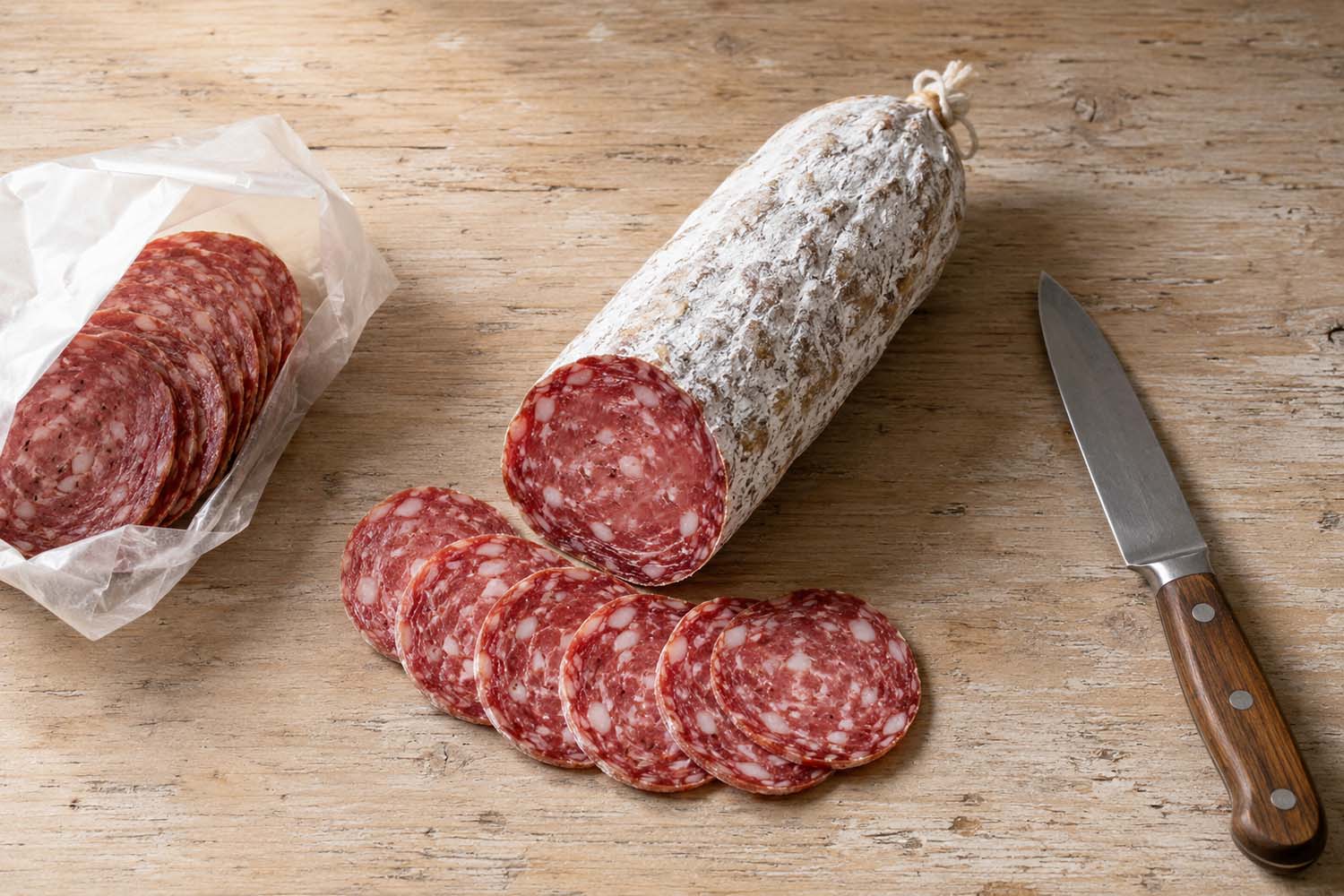
You pull a whole dry salami out of the back of the pantry. It has been there for a few weeks and the outside is covered in white powder. In the fridge, there is an open pack of sliced Genoa salami from last Tuesday. Both look a little questionable. But they are completely different products with completely different shelf lives, and the white stuff on the dry salami is not what you think it is.
Does salami go bad?
The short answer: Yes, salami goes bad, but when depends entirely on which type you have. Whole, unopened dry salami lasts up to 6 weeks in the pantry or indefinitely in the refrigerator per USDA guidance. Once cut, refrigerate and use within 3 weeks. Sliced deli salami lasts 3 to 5 days opened in the fridge. Cooked salami lasts 7 days after opening. The white mold on dry salami is not a spoilage sign. It is intentional, safe, and part of the curing process.
For more on storing deli meats and perishable foods, see the Food Storage Guide.
Key Takeaways
- Whole dry salami, unopened: 6 weeks pantry or indefinitely refrigerated (USDA)
- Whole dry salami, cut: refrigerate and use within 3 weeks
- Sliced deli salami (packaged, opened): 3 to 5 days refrigerated
- Cooked salami (Mortadella, Salami Cotto), opened: 7 days refrigerated
- White mold on dry salami casing: safe, intentional, part of the curing process
- Black, green, or brown fuzzy mold: discard
Three Types of Salami With Three Different Shelf Lives
Salami is not one product. The word covers a wide range of cured and cooked meats that behave very differently when it comes to storage. Getting the shelf life right depends on knowing which category your salami falls into.
Dry-cured salami (Genoa, hard salami, soppressata, cacciatore, pepperoni) is fermented, salted, and slowly air-dried over weeks or months. The drying process removes enough moisture that the whole, intact product is shelf-stable before opening. This is the salami you find hanging unrefrigerated in delis, specialty stores, and some grocery aisles. It has the longest shelf life of any salami type.
Cooked salami (Mortadella, Salami Cotto, some bologna-style products) is made from meat that is cooked or smoked rather than dried. It has a higher moisture content, a shorter shelf life, and must always be refrigerated. It behaves more like a standard cooked deli meat than a dry-cured sausage.
Sliced deli salami sold in refrigerated packaged form or cut at the deli counter is the most perishable of the three regardless of whether the original salami was dry-cured or cooked. Once sliced, the dramatically increased surface area accelerates spoilage. These products always require refrigeration and have a short window after opening.
How Long Does Salami Last?
The USDA FSIS guidance on dry sausage applies directly to dry-cured salami: whole and unopened, it can be stored in the pantry for up to 6 weeks or in the refrigerator indefinitely. Once cut or opened, refrigerate and use within 3 weeks. For cooked salami, the USDA notes cooked sausage lasts up to 2 weeks refrigerated when unopened and 7 days after opening. For sliced deli salami in packaged form, most sources cite 3 to 5 days after opening.
| Type | Pantry (Unopened) | Refrigerator (After Opening) | Freezer |
|---|---|---|---|
| Whole dry-cured salami (Genoa, hard, soppressata) | Up to 6 weeks | 3 weeks (USDA FSIS) | Up to 10 months |
| Cooked salami (Mortadella, Salami Cotto), unopened | Refrigerate only | 7 days after opening | 1 to 2 months |
| Sliced deli salami (packaged, refrigerated section) | Refrigerate only | 3 to 5 days after opening | 1 to 2 months |
| Deli-counter sliced (cut to order) | Refrigerate only | 3 to 5 days | 1 to 2 months |
The White Mold on Salami Is Not a Spoilage Sign
This is the most important thing to understand about dry-cured salami, and the question most competitors answer poorly or not at all. The white powdery or fuzzy coating on the outside of a whole dry-cured salami is not a sign the salami has gone bad. It is Penicillium nalgiovense, a strain of beneficial mold that is deliberately inoculated onto the casing before fermentation as a centuries-old technique in traditional salumi production.
The mold serves two purposes. It protects the salami from harmful bacteria and undesirable mold by colonizing the surface first. And it contributes to flavor, adding a mild earthiness similar to the rind on a Brie or Camembert. On commercially produced salami using approved starter cultures, this mold is safe to eat on the casing or to wipe off with a clean cloth before slicing. Il Porcellino Salumi, an artisan producer, describes it as a penicillin-based mold that adds unique flavor and flora while protecting the product throughout the drying process. Either approach is fine on commercial products.
White mold on dry salami: safe
- Dry, powdery, or slightly fuzzy white coating on the casing
- Penicillium nalgiovense: intentionally introduced, protective, edible
- Can be eaten on the casing or wiped off. No effect on the meat inside.
- May reappear in the fridge after slicing. This is normal.
Mold that means discard:
- Black, green, or brown fuzzy growth anywhere on the salami
- Any mold on sliced deli salami or cooked salami (these should have no mold)
- Wet, slimy, or unusually hairy white growth rather than dry powder
How to Tell If Salami Has Gone Bad
Signs of Spoilage
- Slimy or tacky texture: The most reliable indicator across all salami types. Fresh salami is firm and slightly dry. A slimy or sticky surface means discard immediately.
- Rancid, sour, or ammonia smell: Dry salami has a rich, complex cured meat aroma. A sour, rancid, or sharp ammonia smell means the fat has oxidized or bacteria have taken over.
- Gray edges spreading inward on sliced salami: Some surface discoloration from oxygen exposure is normal on sliced salami. Gray edges that spread inward toward the center of the slice, or uniform grayness throughout, indicates spoilage.
- Black, green, or brown fuzzy mold: Always discard. Unlike the white Penicillium mold on dry-cured casings, these colors indicate undesirable and potentially harmful mold growth.
- Excessive dryness on whole salami: A whole dry salami that has become very hard and desiccated is not necessarily spoiled. The dried exterior can be trimmed and the interior is often still fine if it smells normal and shows no sliminess or discoloration.
How to Store Salami Correctly
Whole dry-cured salami (unopened)
- Store in a cool, dry place. A pantry or cellar shelf away from heat and humidity works well.
- Refrigerating extends shelf life further. Unopened whole salami keeps indefinitely refrigerated.
- If storing in the fridge, loosely wrap in butcher paper or a breathable beeswax wrap rather than tight plastic. The mold on the casing needs to breathe to remain healthy.
Whole dry-cured salami (after cutting)
- Wrap the cut end in butcher paper or parchment, then loosely in plastic or a zip-top bag. Avoid sealing too tightly, which traps moisture and can promote bad mold.
- Refrigerate on an interior shelf, not the door.
- Use within 3 weeks of the first cut.
Sliced and cooked salami
See also

- Keep refrigerated at all times.
- Reseal the package tightly or transfer to an airtight container after opening.
- Store away from raw meat on an interior shelf.
- Sliced deli salami: use within 3 to 5 days of opening. Cooked salami: use within 7 days.
Recipes That Use Salami
If you have sliced salami to use before it turns, it works beautifully on a grazing board alongside cheeses, olives, and pickled vegetables. Beyond boards, salami is excellent chopped into pasta salads, layered into stromboli or calzones, folded into frittatas, or served as a quick appetizer with good crackers and mustard. It also makes a fast pizza topping that crisps better than pre-sliced pepperoni due to its firmer texture. For more on the USDA’s dry sausage guidelines, see the USDA FSIS sausage and food safety page.
FAQ: Is Dry-Cured Salami Ready to Eat Straight From the Package?
Yes. Commercially produced dry-cured salami is a ready-to-eat product. The fermentation, curing, and drying process makes it safe to eat without cooking. This is true for Genoa, hard salami, soppressata, and similar varieties. Cooked salami varieties like Mortadella are also ready to eat. If a salami requires cooking, the label will say so explicitly.
FAQ: Can You Eat Salami Past the Expiration Date?
For whole dry-cured salami that has been stored properly, a few days to a week past the printed date is often fine if it smells normal, feels firm, and shows no sliminess or discoloration. The printed date on dry-cured products is a quality indicator, not a hard safety cutoff. For sliced deli salami or cooked salami, stay much closer to the date. Once opened, the opening date matters more than the printed date regardless of type.
FAQ: Is Salami Safe to Eat When Pregnant?
The USDA advises that people at higher risk for foodborne illness, including pregnant women, should consider avoiding dry-cured salami that has not been cooked, because the fermentation and drying process does not involve a cooking step that would eliminate all pathogens including E. coli O157:H7, Salmonella, and Listeria monocytogenes. Cooking salami (on a pizza, in a pasta dish, or in a heated sandwich) eliminates this concern. Cooked salami varieties like Mortadella are cooked during production but carry their own Listeria risk as a ready-to-eat deli meat. Pregnant women should follow their healthcare provider’s guidance on deli meat consumption.
FAQ: Can You Freeze Salami?
Yes. Whole dry-cured salami freezes well for up to 10 months. Slice before freezing if you plan to use it in portions, placing parchment paper between slices and storing in a zip-top freezer bag. Sliced deli salami and cooked salami can be frozen for 1 to 2 months but may change in texture after thawing. Thaw overnight in the refrigerator. Do not refreeze once thawed.
Further Reading
Better Living may earn commissions through affiliate links and may occasionally feature sponsored or partner content. If you make a purchase through our links, we may receive a small commission at no cost to you.