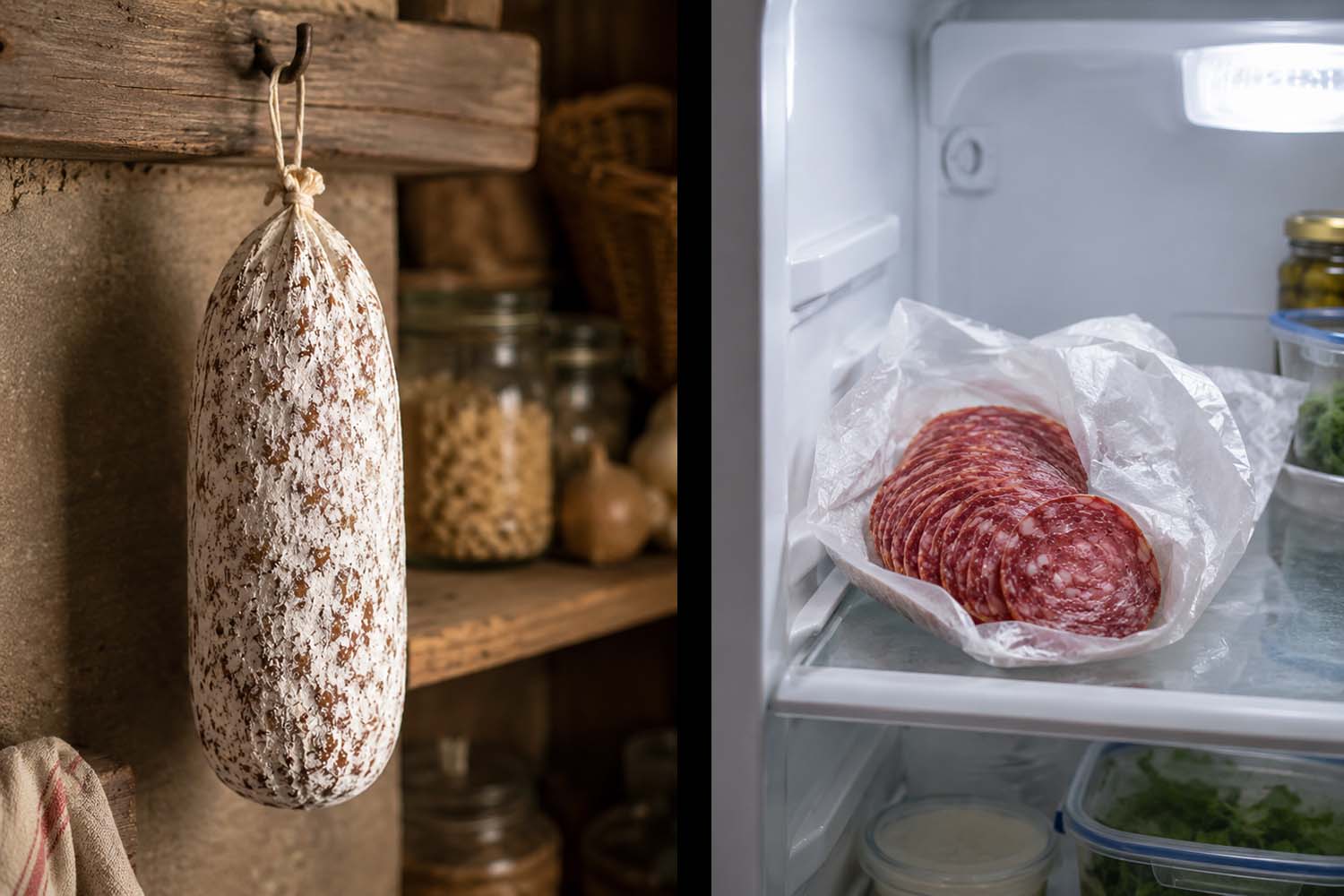
You bought a whole Genoa salami from the unrefrigerated section of a specialty store and now you are not sure whether it goes in the pantry or the fridge. On the counter, there is leftover sliced salami from a charcuterie board last night. Same name, completely different storage needs.
Does salami need to be refrigerated?
The short answer: It depends on the type. Whole, unopened dry-cured salami is shelf-stable and does not require refrigeration before opening. It can be stored in a cool, dry pantry for up to 6 weeks. Once cut, it must be refrigerated and used within 3 weeks. Sliced deli salami and cooked salami must always be refrigerated. When in doubt, match storage to where you bought it.
For more on storing deli meats and cured products, see the Food Storage Guide.
Key Takeaways
- Whole dry salami, unopened: no refrigeration needed; cool dry pantry up to 6 weeks
- Whole dry salami, after cutting: must refrigerate; use within 3 weeks
- Sliced deli salami (packaged or counter-cut): always refrigerate; use within 3 to 5 days of opening
- Cooked salami (Mortadella, Salami Cotto): always refrigerate; use within 7 days of opening
- Rule of thumb: if it was sold cold, keep it cold
Does Whole Dry-Cured Salami Need to Be Refrigerated?
No, not before opening. Whole, intact dry-cured salami is a shelf-stable product. The USDA FSIS classifies it alongside pepperoni and other hard or dry sausages as a product that can be stored in a cool, dry pantry for up to 6 weeks without refrigeration. This is why you find whole salami hanging unrefrigerated in Italian delis, specialty grocery stores, and some charcuterie shops. The fermentation, salt, and drying process removes enough moisture and acidity to prevent harmful bacterial growth at room temperature.
Refrigerating an unopened whole salami extends its life significantly. Kept continuously cold, an unopened whole dry-cured salami lasts indefinitely per USDA guidance, though quality is best within 6 months before the fat starts to oxidize and flavor degrades.
One important storage note for whole dry-cured salami in the fridge: wrap it loosely in butcher paper or breathable beeswax wrap rather than sealing it tightly in plastic. The beneficial white Penicillium mold on the casing needs to breathe. Tight plastic wrap traps moisture and can promote undesirable mold growth beneath the casing.
Does Salami Need to Be Refrigerated After Cutting?
Yes, immediately. Once you cut into a whole dry-cured salami, the interior is exposed to air and bacteria. Refrigerate the cut salami promptly and use within 3 weeks per USDA FSIS guidance. Wrap the cut end in butcher paper first, then loosely in plastic or place in a zip-top bag with some air left inside to avoid excess moisture buildup against the cut surface.
Does Sliced Deli Salami Need to Be Refrigerated?
Yes, always. Pre-sliced salami sold in refrigerated packages or cut at the deli counter must be kept cold at all times, opened or not. The increased surface area of sliced salami makes it far more susceptible to bacterial growth than the intact whole product. Treat sliced salami the same as any other deli meat. Keep it at 40 degrees Fahrenheit or below. Use within 3 to 5 days of opening the package. Deli-counter sliced salami should also be used within 3 to 5 days.
Does Cooked Salami Need to Be Refrigerated?
Yes, always. Cooked salami varieties including Mortadella, Salami Cotto, and similar products are not shelf-stable at any stage. They were cooked rather than dried, which means they retain more moisture and have a shorter shelf life than dry-cured varieties. Store in the refrigerator at all times. Unopened cooked salami keeps up to 2 weeks refrigerated. Once opened, use within 7 days per USDA guidance on cooked sausage.
How to Store Each Type Correctly

Whole Dry-Cured Salami (Unopened)
- Cool, dry pantry away from heat and humidity. A cellar or lower cabinet works well.
- Do not store near the stove or in direct sunlight.
- For maximum shelf life, refrigerate in original packaging or loosely wrapped in butcher paper.
- Do not seal in tight plastic. The mold on the casing needs airflow.
Whole Dry-Cured Salami (After Cutting)
- Wrap the cut end in butcher paper or parchment first, then loosely in plastic or a zip-top bag.
- Refrigerate on an interior shelf, not the door.
- Use within 3 weeks of the first cut.
- If white mold reappears on the cut end or casing in the fridge, it is normal. Wipe off before slicing.
Sliced and Cooked Salami
- Refrigerate at all times. Never leave out more than 2 hours.
- Reseal the package tightly after each use or transfer to an airtight container.
- Store on an interior shelf away from raw meat.
- Sliced deli salami: use within 3 to 5 days of opening.
- Cooked salami: use within 7 days of opening.
See also

Recipes That Use Salami
Working through sliced salami before it turns? It works beautifully on a grazing or meze board with cheeses, olives, and bread. Beyond boards, fold it into a frittata, layer it into a stromboli, chop it into a pasta salad, or use it as a quick pizza topping that crisps well in the oven. For the USDA’s complete guidance on dry and cooked sausage storage, see the USDA FSIS sausage and food safety page.
FAQ: Can Salami Be Left Out Overnight?
It depends on the type. A whole, unopened dry-cured salami left out overnight in a cool dry environment is fine: it is shelf-stable. A cut whole salami or any sliced or cooked salami left out at room temperature overnight should be discarded. The USDA 2-hour rule applies: once opened or cut, salami left at room temperature for more than 2 hours should not be eaten regardless of how it looks or smells.
FAQ: Why Is Some Salami Sold Unrefrigerated?
Whole dry-cured salami is shelf-stable because the fermentation, salt curing, and drying process removes enough moisture to prevent bacterial growth at room temperature. The water activity of a properly dried salami is low enough that most harmful bacteria cannot thrive. Once the casing is cut or the vacuum seal is broken, that protection ends and refrigeration becomes necessary. For a full explanation of how the curing process works, see does salami go bad.
FAQ: Does Salami Need to Be Refrigerated Before Opening if Bought From the Refrigerated Section?
Yes. If the salami was sold from a refrigerated case, keep it refrigerated. Some whole dry-cured salami is sold refrigerated as a matter of retailer preference or because it contains less drying. The simple rule: match storage to where you bought it. Refrigerated section means keep it cold. Unrefrigerated pantry shelf means room temperature storage is fine until opening.
Further Reading
Better Living may earn commissions through affiliate links and may occasionally feature sponsored or partner content. If you make a purchase through our links, we may receive a small commission at no cost to you.